
Siding Contractor in Harper, KS
Your local siding contractor for Harper and Harper County — siding installation, replacement, and repair, including the cracked corners and separating joints that mean the ground under your house is moving, not that your siding wore out.
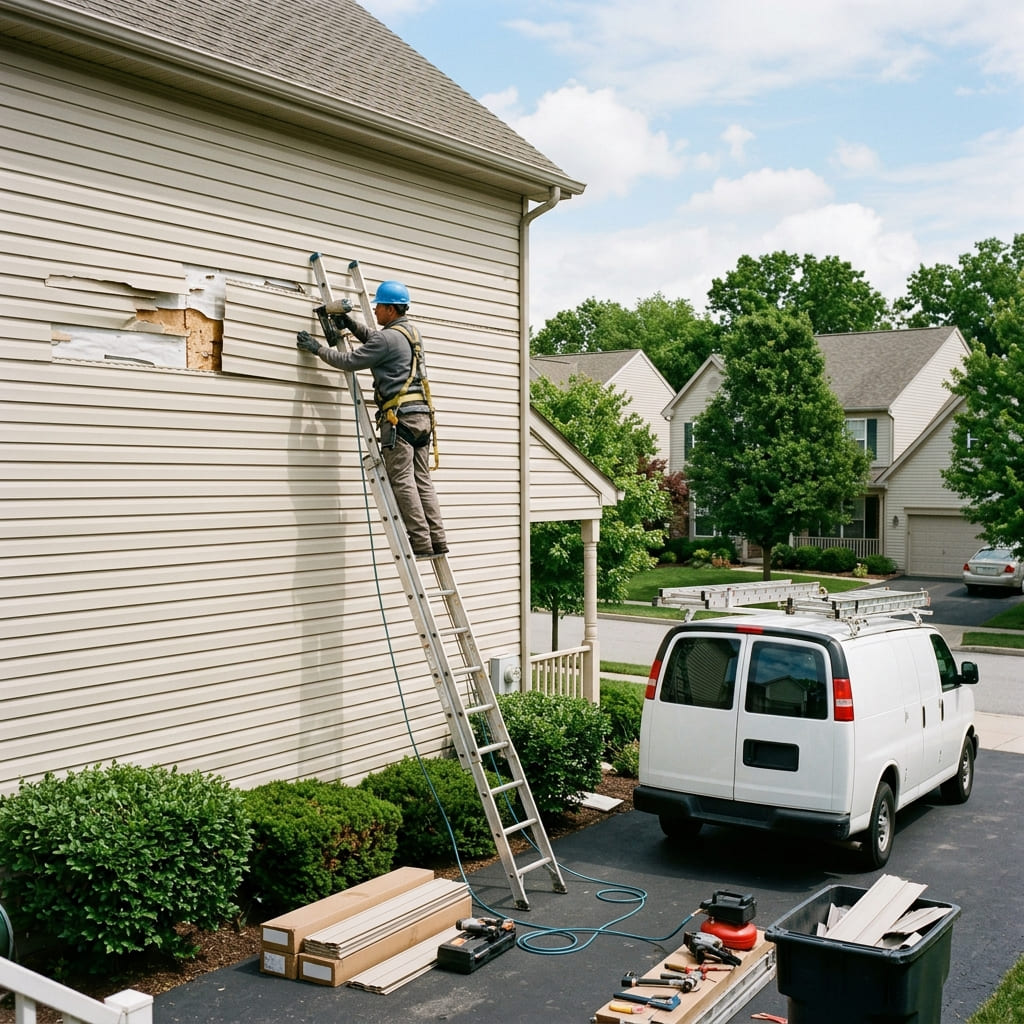
Siding Installation & Repair in Harper, KS
Harper was founded in 1877 by a colony out of Iowa. The post office opened that May under the name Cora City and was renamed Harper the following June, for Sergeant Marion Harper of the 2nd Kansas Cavalry, who was killed in the Civil War. The city incorporated in 1880, and today it holds 1,313 people across 1.63 square miles at 1,417 feet, with the old depot still standing as a reminder of what put the town on the map.
Nine and a half miles northeast lies one of the strangest footnotes in Kansas history. Runnymede was an English colony founded by Francis J. S. Turnley, incorporated in 1886, that drew roughly a hundred young Englishmen, Irishmen and Scots to the prairie. It had polo grounds, a steeplechase course, a race track, tennis courts, a football field and a three-story hotel; the Episcopal church cornerstone was laid on November 28, 1889 and dedicated the following May. When it became clear in 1892 that the railroad was not coming, Turnley left in July and the colony evaporated. It is a good story about the difference between what gets built on top of the ground and what the ground itself decides.
That is not a stretched metaphor. In Harper it is the actual technical problem. The most common reason we get called out to look at siding here is not hail, not wind, and not a material at the end of its life. It is a house that is moving, and siding is simply the part of the house that shows it first.
South-central Kansas sits on clay-rich soils, and clay is not inert. The clay minerals in it take on water and expand, then give it up and contract. Over a full wet-and-dry cycle the ground surface can move an inch or two vertically, and in extreme conditions considerably more. Kansas has had two hard droughts inside fifteen years — 2011 through 2013, and again 2022 through 2023 — and in both of them soil around houses shrank away from footings badly enough to cause visible settlement. Then the rain comes back and the clay swells again. Your house is riding on that.
The movement is never uniform, which is the part that does the damage. The north wall stays shaded and damp; the south and west walls bake. One corner has a mature tree pulling hundreds of gallons a day out of the soil in July. The drip line under a roof with no gutter gets soaked in every storm while the ground six feet out stays dry. A downspout dumping at the foundation on one side keeps that corner swollen year-round while the opposite corner shrinks. Differential movement is what racks a frame, and a racked frame is what your walls report.
Siding is where it shows because siding is rigid in plane and it spans the openings. Look for diagonal cracks running out from the upper or lower corners of windows and doors. Look for butt joints that have opened enough to show housewrap or felt, concentrated on one elevation rather than spread evenly around the house. Look along a course of lap siding with one eye closed and see whether it still runs parallel with the eave. Look for caulk at a corner board that splits every single year no matter how carefully it was tooled, a row of nail pops, or trim that has pulled away at one end and nowhere else. Then go inside and check whether the door in that same corner of the house has started to catch on its jamb, and whether there is a matching diagonal in the drywall above the window. Two or three of those on the same elevation is a structural conversation.
Here is the part that costs people money in this town, and it is the reason this page exists. New siding will not fix any of it. Cladding hangs on the structure — it does not stiffen it, it does not bridge it, and it cannot outvote the ground. Re-side a house that is still moving and you have spent the whole budget, covered up the evidence a foundation engineer would have wanted to look at, and bought yourself the same cracks in fresh material inside two or three seasons. Worse, foundation repair usually involves lifting, and lifting moves the wall planes, so rigid cladding installed beforehand often has to be disturbed again anyway.
The correct order is drainage, then structure, then cladding. Drainage first because it is cheap and it is frequently the whole answer: gutters that actually work and downspouts discharging six feet or more from the wall rather than at the footing; grade sloping away from the house about six inches over the first ten feet; no flower bed dammed up against the foundation holding water; a check on supply and sewer lines, because a slow leak under a slab will move a corner faster than any drought. In a genuine drought, soaker hose on a timer around the perimeter to keep the soil moisture steady — the goal is consistency, not saturation. Then, if the movement is significant, a foundation opinion. Then we clad it.
When it is time for the cladding, the material choice actually changes on a house with a movement history. Vinyl is hung with deliberate slack so every panel floats on its fasteners, and that same tolerance which lets it handle its own thermal expansion quietly absorbs small frame movement as well — on a house that shifts a little, the cheapest material is genuinely the most forgiving one. Fiber cement and wood are superb materials but they are rigid and fastened tight, so they report movement as cracked joints, and if we install them on a house with this history we detail the joints differently and tell you why. Stone veneer is the least forgiving of all.
Siding Pros KS handles siding installation, siding replacement, and siding repair across Harper and Harper County, and we would genuinely rather write you a small drainage-and-repair estimate today than a large re-siding estimate that fails in three years. We are in Anthony, Kingman, and Medicine Lodge regularly, so Harper is an ordinary run for us. Start with the signs you need new siding or the Kansas siding cost guide, then call and we will walk the whole house with you and tell you honestly which of the two problems you have.
Popular siding services in Harper
Why Harper, KS Homeowners Choose a Local Siding Crew
Local, not storm-chasers
We work Harper year-round, not just the few weeks after a storm rolls through. When the wall needs attention down the road, the same number still reaches us.
Fast storm response
After hail or high winds hit Harper County, exposed walls can't wait. We prioritize Harper storm damage to keep water out of your home.
Insurance claim help
We document Harper storm damage with photos and detailed estimates and meet your adjuster on site so nothing gets missed.
Good to know before you call.
My siding cracks at the window corners every year. Is that a siding problem?
Usually not, and this is the single most useful thing we can tell a Harper homeowner. Cracks that radiate diagonally from the upper or lower corners of a window or door opening are the classic signature of the structure moving, not of the cladding wearing out. The opening is the weak point in the wall, so when the frame racks even slightly, the stress concentrates at those corners and the rigid material spanning them splits. You will often find the same diagonal running through the drywall on the inside of that same corner. If you replace the siding and leave the movement alone, the new material cracks in exactly the same place, generally within two or three seasons.
How do I tell movement damage from siding that is simply worn out?
Look at whether the damage is directional or general. Material at the end of its life fails everywhere at once and fails in ways related to weather and sun — chalking, fading, brittleness, hail impact, rot at the wet spots. Movement damage is localized and it points somewhere. The tells are diagonal cracks from opening corners, butt joints that have opened wide enough to show housewrap at one end of the house but nowhere else, a course of lap siding that is no longer parallel with the eave line, caulk at a corner board that splits open every single year no matter how well it was tooled, a line of nail pops, and doors or windows in that same corner of the house that have started to bind. Two or three of those together on one elevation is a structural conversation, not a siding conversation.
Should I re-side before or after foundation work?
After, without exception, and we will turn down the job rather than do it the other way round. Siding is a cladding. It hangs on the structure; it does not hold the structure up, and it cannot bridge a frame that is still moving. If you re-side a house that is actively settling you have spent the money, you have covered up the evidence a foundation engineer would want to see, and you get to watch fresh material crack along the same lines. Foundation work also frequently involves lifting, and lifting a house moves the wall planes, which means anything rigid attached to them has to be dealt with anyway. Fix the ground and the footing, give it a season to settle where that is practical, then clad it.
Does watering my foundation in a drought actually help?
Yes, and it is close to the cheapest thing you can do for a house on clay. Expansive clay changes volume with moisture — it swells when it is wet and shrinks when it dries — and in a hard Kansas drought like 2011 through 2013 or 2022 through 2023 the soil around a house can shrink away enough that the footing loses support and the house drops. It never drops evenly, because the shaded north side stays damper than the baked south side and a mature tree pulls hundreds of gallons out of one corner. The point of soaker hose on a timer around the perimeter is not to soak the ground, it is to keep the moisture content steady so the clay does not swing. Consistency is what protects you, and sudden heavy watering on soil that has already cracked open can be worse than none.
Which siding handles a house that moves a little?
Vinyl, by a clear margin, and this is one of the few cases where the cheapest material is genuinely the technically correct one. Vinyl is hung on nails with deliberate slack so each panel floats and slides — it is designed to accommodate its own thermal movement, and that same tolerance quietly absorbs small frame movement too. Fiber cement and wood are excellent materials but they are rigid and fastened tight, so they telegraph movement as cracks at the joints. Masonry and stone veneer are the least forgiving of all. That does not rule out fiber cement on a Harper house, but if there is a known movement history it changes the conversation, and it changes how we detail the joints. The materials comparison covers the rest of the trade-offs.
Is Harper too far out for you to come?
No. Siding Pros KS works Anthony and Kingman regularly, and Harper sits between Anthony and Kingman in the same corner of the state, so the drive is already part of our week. We would rather be straight about scheduling than promise you a start date we cannot hold — small towns out here get told a lot of things by crews that are three states away by August. If a trip charge applies it is written on the estimate before you agree to anything, not discovered afterwards.
Harper siding project on your list? Let's handle it.
Free written estimates, honest timelines, and siding detailed for Kansas weather.