
Siding Contractor in Sedgwick, KS
Your local siding contractor for Sedgwick and the Harvey County line — siding installation, replacement, and repair, with a hard focus on the bottom of the wall, where houses this close to the Little Arkansas River fail first.
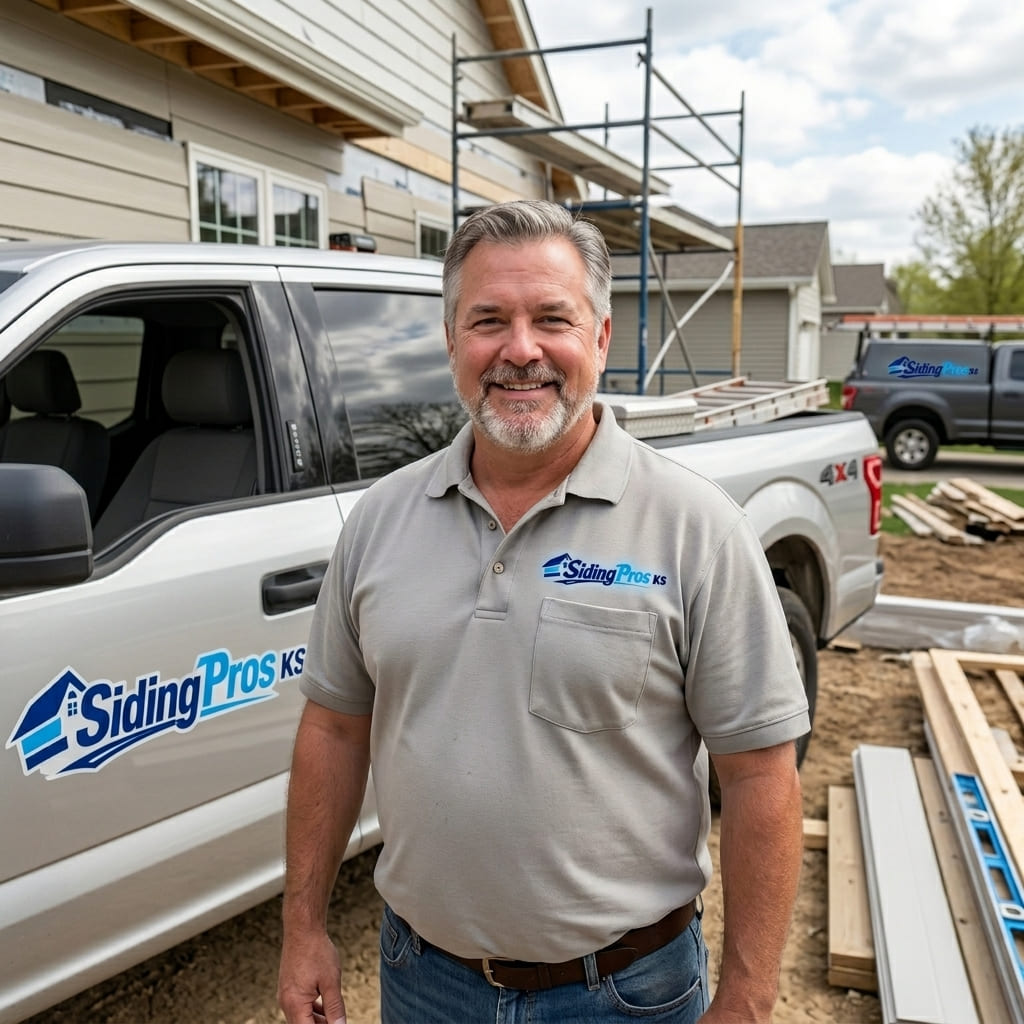
Siding Installation & Repair in Sedgwick, KS
Sedgwick is the oldest town in Harvey County, laid out in June 1870 by the Sedgwick Town Company on the Little Arkansas River about ten miles southwest of Newton. Roughly 1,600 people live here, and the city limits famously straddle the Harvey and Sedgwick county line, which means half the town votes in one county and half in the other. It is an old railroad town on a small river, and both of those facts turn up in its walls.
Siding Pros KS works Sedgwick regularly, and we approach a house here differently than we do one on higher ground. On most Kansas homes you inspect from the roofline down. In Sedgwick you start at the dirt.
The reason is hydrology. Sedgwick sits at the eastern edge of the Equus Beds aquifer, and the Little Arkansas functions as that aquifer’s natural drain — river flow at base conditions is directly tied to how high the water table stands. In practical terms, the ground around a Sedgwick house holds available moisture far longer than the ground around a house fifteen miles west on open upland. Soil beside your foundation that would dry out in three days somewhere else stays damp for a week or more here.
A wall does not care about aquifers in the abstract. What it cares about is that the bottom eight inches of siding is in constant company with wet ground. That band takes splash-back from every rain that hits the soil beside it, spray from sprinklers and downspouts, wicking from damp earth, and snow that drifts against the wall and melts slowly instead of running off. It is the wettest part of the building envelope on any house, and in Sedgwick it stays wet longest.
So the failure pattern here is inverted from what most homeowners expect. The top of the wall looks fine. The middle looks fine. The bottom two or three courses are soft, or the paint is peeling in a band, or the siding sounds hollow when you tap it near grade, or there is a line of dark staining that no amount of washing removes. On wood siding it is outright rot, and it invites carpenter ants and termites into the framing behind it. On vinyl the panel itself survives — vinyl does not rot — but vinyl is not a water barrier either, and the water that gets behind it goes straight into the sheathing and the sill plate.
Three things cause it more than anything else, and all three are fixable. First, insufficient clearance: siding should generally sit at least six inches above finished grade and roughly two inches above a hard surface like a patio or sidewalk, and on a lot of older Sedgwick homes the flower beds have crept up over the decades until the siding is buried in the mulch. Second, downspouts discharging right at the foundation instead of being carried away from it. Third, sprinkler heads that clip the wall — a head that hits the siding several times a week all summer puts more water on that band than the weather does, on a far more reliable schedule.
The good news is that bottom-of-wall damage is often the cheapest serious repair in siding. If the rot is confined to the lower courses and the starter strip and the sheathing above is sound, we cut back to solid material, replace the damaged sheathing, re-flash, re-set the starter strip at proper clearance, and re-side that band. On lap siding the repair blends. What we will not do is put new material back over a cause we have not addressed, so if a downspout, a grade slope, or a sprinkler is feeding the problem, that goes in the report with the photos.
When a full replacement is warranted, material choice matters more here than in most towns. James Hardie fiber cement is the strongest option low on the wall: it does not rot, it does not feed insects, and it tolerates incidental moisture well as long as the required ground clearance is respected. A quality vinyl is rot-proof in itself, but on a lot like this the housewrap and flashing behind it are carrying the real load, so we detail them accordingly. Untreated wood within splash range of damp Sedgwick ground is a maintenance commitment we will be honest with you about before you sign anything.
Sedgwick also gets everything else Kansas hands out — the hail, the straight-line wind off open ground north of town, the freeze-thaw cycling that opens seams a little further each winter. Our storm damage siding repair page covers the insurance side of that, and we document wall damage with photographs and a line-item estimate and meet your adjuster at the house.
Siding Pros KS handles siding installation, siding replacement, and siding repair across Sedgwick and both counties it sits in, licensed, insured, Kansas-owned, with free inspections and written pricing. We are through Newton, North Newton, and Halstead most weeks. If you want to know what shape the bottom of your walls is in, read the signs you need new siding or call and we will come check it.
Popular siding services in Sedgwick
Why Sedgwick, KS Homeowners Choose a Local Siding Crew
Local, not storm-chasers
We are a Kansas crew, not an out-of-state caravan. When your Sedgwick siding needs service down the road, we are still here to back it up.
Fast storm response
After hail or high winds hit Harvey County, exposed walls can't wait. We prioritize Sedgwick storm damage to keep water out of your home.
Insurance claim help
We document Sedgwick storm damage with photos and detailed estimates and meet your adjuster on site so nothing gets missed.
Good to know before you call.
My siding is rotting at the bottom of the wall but fine everywhere else. Why?
Because that is where the water is. The bottom eight inches of a wall takes splash-back from every rain that hits the ground beside it, spray from sprinklers and downspouts, wicking up from damp soil, and snow that piles against the house and melts slowly. In Sedgwick that is worse than average, because the town sits on the Little Arkansas River at the eastern edge of the Equus Beds and the water table here runs high — the river is effectively the aquifer’s natural drain, so ground moisture stays available to a wall far longer than it does on higher ground. Siding Pros KS starts every inspection here at the bottom of the wall for exactly that reason.
How much clearance should siding have above the ground?
As a general rule, keep the bottom of the siding at least six inches above finished grade, and roughly two inches above a hard surface like a patio, driveway, or sidewalk. Manufacturer instructions and local code govern the specific number, and fiber cement in particular has published clearance requirements that must be met to keep the warranty intact. The reason for the gap is simple: it lets the bottom edge dry, and it keeps the siding out of the splash zone and out of contact with wet soil. A great many older Sedgwick homes have siding buried in a flower bed that was raised over the years, and the rot is entirely predictable.
Can you fix just the bottom courses, or does the whole wall have to be replaced?
Frequently just the bottom, and that is usually the right call. If the damage is confined to the lower courses and the starter strip, and the sheathing above is sound, we can cut back to solid material, replace the rotted sheathing, re-flash, re-set the starter with proper clearance, and re-side that band. On lap siding the repair blends well. The catch is that bottom-of-wall rot is often a symptom of something upstream — a downspout dumping at the foundation, grade sloping toward the house, or a sprinkler head aimed at the wall — and if that is not fixed too, the repair will fail again. We flag it either way. See our siding repair page.
Are my sprinklers really damaging my siding?
They are one of the most reliable causes of it we see. A sprinkler head that clips the wall puts water on the same eight inches of siding several times a week, every week of the growing season, on a schedule far more consistent than rain. Wood siding takes the worst of it. Vinyl survives it but the water goes behind the panel and into the sheathing all the same, and hard water leaves mineral staining that will not wash off. Turning or shielding two heads is the cheapest siding repair anyone will ever recommend to you. Our siding maintenance guide covers the rest of the seasonal checklist.
What siding material holds up best this close to the river?
For the bottom of the wall specifically, James Hardie fiber cement is the strongest choice — it does not rot, it does not feed termites or carpenter ants, and it tolerates incidental moisture in a way wood cannot, provided the required ground clearance is respected. Vinyl is also immune to rot itself, but it is not a water barrier, so on a high-water-table lot the housewrap and flashing behind it are doing the real work. What we would not recommend within splash range of damp ground in Sedgwick is untreated wood. Our materials comparison lays out the options.
Do you serve Sedgwick even though it straddles two counties?
Yes. Sedgwick sits on the Harvey and Sedgwick county line, which occasionally confuses service-area lists, but not ours. Siding Pros KS covers both counties and runs Newton, Halstead, and the north Wichita suburbs regularly, so Sedgwick is a routine stop about ten miles down the road rather than a special trip. Any trip charge, if one applies at all, appears on your written estimate before you agree to anything.
Sedgwick siding project on your list? Let's handle it.
Free written estimates, honest timelines, and a local crew that stands behind the work.