
Siding Contractor in Buhler, KS
Your local siding contractor for Buhler and Reno County — siding installation, replacement, and repair, with attention to the wind-driven sand that scours south walls and packs the drainage slots shut on homes out here.
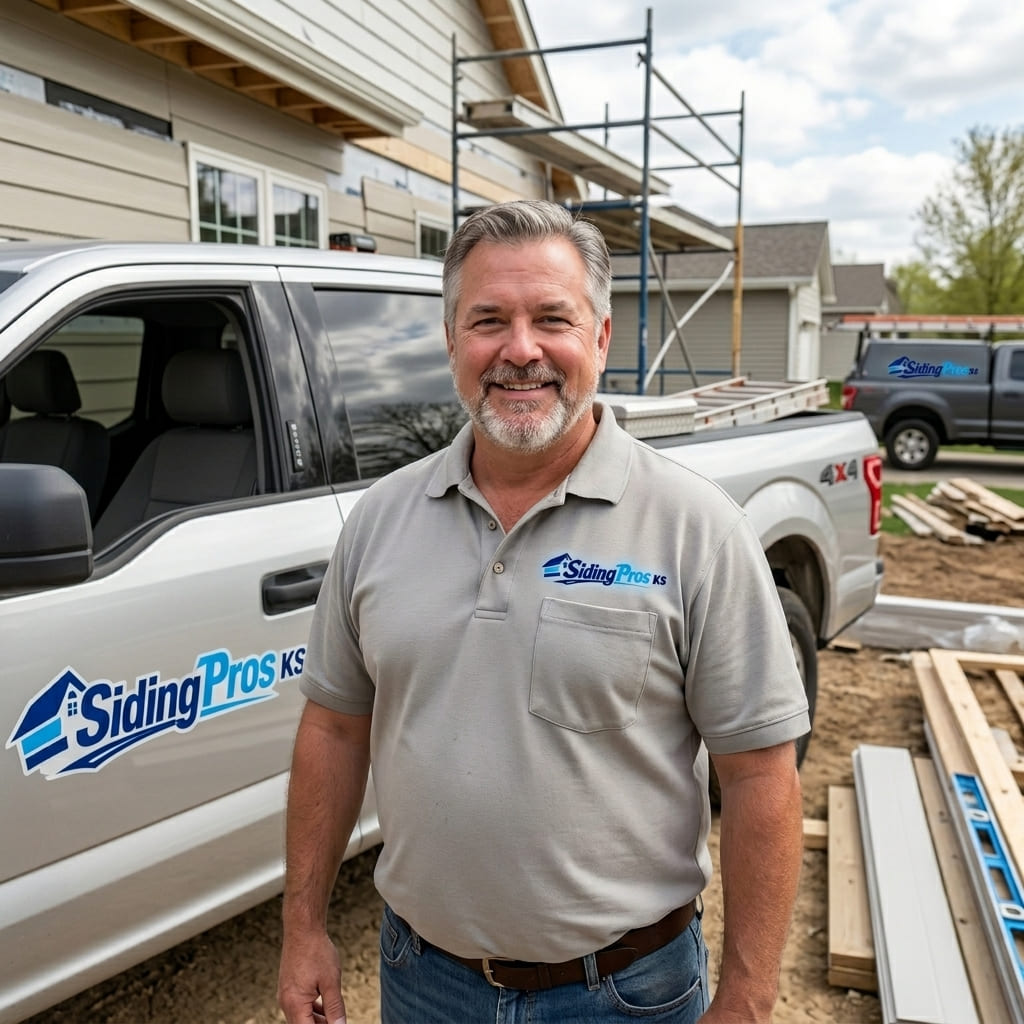
Siding Installation & Repair in Buhler, KS
Buhler is a Reno County town of 1,325 people at the 2020 census, founded in 1888 and incorporated in 1913, settled largely by Mennonite families who had emigrated from Russia during that decade. It sits about ten miles northeast of Hutchinson in some of the most productive farm ground in the state — and on some of the sandiest. Reno County is genuine sand prairie country. Sand Hills State Park, roughly eleven hundred acres of preserved dunes, grassland, and wetland, lies just southwest of town between here and Hutchinson.
That soil is the reason Siding Pros KS writes estimates differently in Buhler than we do thirty miles east. Most of central Kansas is a hail conversation. Buhler is an abrasion conversation, and it is one almost nobody has with homeowners before selling them a wall.
Here is what people notice first: the south and west elevations look tired years before the rest of the house does. The obvious explanation is sun, and sun is part of it — UV breaks down pigment on any material. But run your hand across a twenty-year-old south wall in this town and you will often feel something a purely sun-faded wall does not have, which is texture. The surface has been physically worn. Fine airborne sand, carried on the prevailing south and southwest winds across open cultivated ground with very little to slow it, works like an extremely patient sandblaster. It takes the gloss off vinyl, cuts through the top coat on painted wood, and dulls the finish on anything with a thin surface layer.
By itself that is cosmetic, and we will tell you so. A dull south wall is not a structural emergency. The reason we bring it up at all is that the same wind carrying that sand is also depositing it somewhere, and where it ends up is the part that costs money.
It ends up in the weep slots. This is worth understanding even if you never call us, because it is the most common hidden problem we find on Buhler homes and homeowners are almost never told the slots exist. Vinyl siding is not a waterproof skin — it is a rain screen. It is designed and expected to let some water past it in a driving rain, and it manages that water by draining it down the back of the panels and out through small slots punched along the bottom edge of each course. Those slots are the drain in the system.
Pack them with fine sand and the system stops working. Water still gets behind the panels, because that is how the wall is designed to behave, but now it has nowhere to exit. It pools on the back of the bottom course, wicks into the housewrap laps, and sits against the sheathing through every wet stretch. Give it a few years and you have soft OSB behind an exterior that still looks perfectly fine from the driveway. We have opened walls in this town where the siding had another fifteen good years in it and the sheathing behind was already gone.
Finding it takes about ten minutes and no demolition. On a free inspection, Siding Pros KS checks the weeps along the lowest courses, checks whether landscape rock or soil has crept up and buried the bottom course entirely, looks for caulk where caulk should never be — the bottom edges of panels and the sides of J-channel around windows, which well-meaning homeowners and bad contractors seal shut thinking they are keeping weather out — and takes moisture readings at the base of the wall on the exposures that matter. We photograph it and it goes in the written estimate.
Often the fix is maintenance rather than replacement, and we would rather tell you that and keep your number than sell you a wall you do not need for another decade. Once a year, rinse the bottom courses with a garden hose on ordinary spray to flush the grit out. Keep grade and landscape rock down off the siding. Leave the weeps and the J-channel alone. That is most of it.
When a Buhler wall genuinely is due, the material choice should account for the grit. Thin builder-grade vinyl with a light surface finish will look worn on a south elevation in ten years out here; a heavier panel with a properly co-extruded finish holds its appearance far longer for a difference in price most people find smaller than expected. James Hardie fiber cement and steel siding both take abrasion very well, and there is nothing wrong with putting a tougher material on the two exposed walls and quality vinyl on the sheltered ones. Behind whatever we hang, we run housewrap lapped shingle-style as a continuous drainage plane, flash every window and door, set expansion gaps and fastener depth to manufacturer spec so nothing buckles in July, and hold the bottom course clear of grade so the wall can actually drain.
Siding Pros KS handles siding installation, siding replacement, and siding repair across Buhler and Reno County — licensed, insured, Kansas-owned, with itemized written pricing and a workmanship guarantee. We are in Hutchinson, South Hutchinson, and Newton most weeks, so Buhler is squarely on our route. Start with the signs you need new siding or the Kansas siding cost guide, then give us a call.
Popular siding services in Buhler
Why Buhler, KS Homeowners Choose a Local Siding Crew
Local, not storm-chasers
We are a Kansas crew, not an out-of-state caravan. When your Buhler siding needs service down the road, we are still here to back it up.
Fast storm response
After hail or high winds hit Reno County, exposed walls can't wait. We prioritize Buhler storm damage to keep water out of your home.
Insurance claim help
We document Buhler storm damage with photos and detailed estimates and meet your adjuster on site so nothing gets missed.
Good to know before you call.
Why is the south side of my house faded and the north side is not?
Out here that is usually two things happening together, and only one of them is sunlight. UV fades pigment, but wind-driven sand physically abrades the surface — it takes the gloss off vinyl and cuts through the top layer of paint on wood and fiber cement. Because our prevailing hard winds come from the south and southwest across open sand prairie, those elevations get both the sun and the grit while the north wall gets neither. If the faded wall also feels slightly rough or looks chalky when you rub it, you are looking at abrasion, not just fade.
Can sand really damage siding?
Steadily, yes. A single windy day does nothing measurable. Twenty years of them is a different story. Reno County sits on genuine sand prairie — Sand Hills State Park, just southwest of Buhler toward Hutchinson, preserves eleven hundred acres of actual dunes — and every field, road ditch, and bare lot around here contributes fine particles to the air. At forty miles an hour that acts like a very slow sandblaster. The functional damage is not the fading, though. It is what the sand does once it collects in the wall.
What does sand do once it gets into the siding?
It packs the weep slots. Vinyl siding is designed to let water out through small slots along the bottom edge of each course, and it is designed to drain down behind the panels to the bottom of the wall and out. Fill those slots with fine sand and the wall stops draining. Water that gets behind the panels in a driving rain — which it always does, by design — now has nowhere to go, so it sits against the housewrap and the sheathing. Siding Pros KS finds packed weeps on Buhler homes constantly, and the homeowner almost never knows the slots exist.
Is there anything I can do about it myself?
Some. Once a year, take a garden hose on a normal spray — not a pressure washer — and rinse along the bottom edge of the lowest courses and around the base of the walls to flush accumulated grit out of the weeps. Keep landscape rock and soil from creeping up over the bottom course, since that buries the drainage path entirely. And do not caulk the bottoms of siding panels or the J-channel around windows shut; people do it thinking they are sealing out weather, and what they actually do is seal water in. Our siding maintenance guide walks through the rest.
Does that mean vinyl is the wrong choice in Buhler?
No, and we install a lot of it here. It means the grade and the detailing matter more than usual. Thin builder-grade vinyl with a light surface finish will look tired on a south wall in ten years; a heavier panel with a proper co-extruded finish holds up dramatically better against grit, and costs less than people assume. Fiber cement and steel both handle abrasion very well if you want the exposed elevations to outlast everything else. We will price the options side by side instead of pushing one.
How long should new siding last on a Buhler home?
A well-chosen, correctly installed vinyl wall should give you thirty to forty years, and fiber cement longer with repainting on a cycle. The variable is rarely the panel — it is whether the wall was built to drain and whether the drainage stays open. That is why we set proper expansion gaps and fastening, keep the bottom course clear of grade, run housewrap lapped shingle-style as a continuous drainage plane, and flash every opening. In sand country the wall that dries is the wall that lasts.
Buhler siding project on your list? Let's handle it.
Free written estimates, honest timelines, and a local crew that stands behind the work.