
Siding Contractor in Inman, KS
Your local siding contractor for Inman and McPherson County — siding installation, replacement, and repair, including the exposed-fastener metal walls out here that leak at the screws and sweat from the inside every winter.
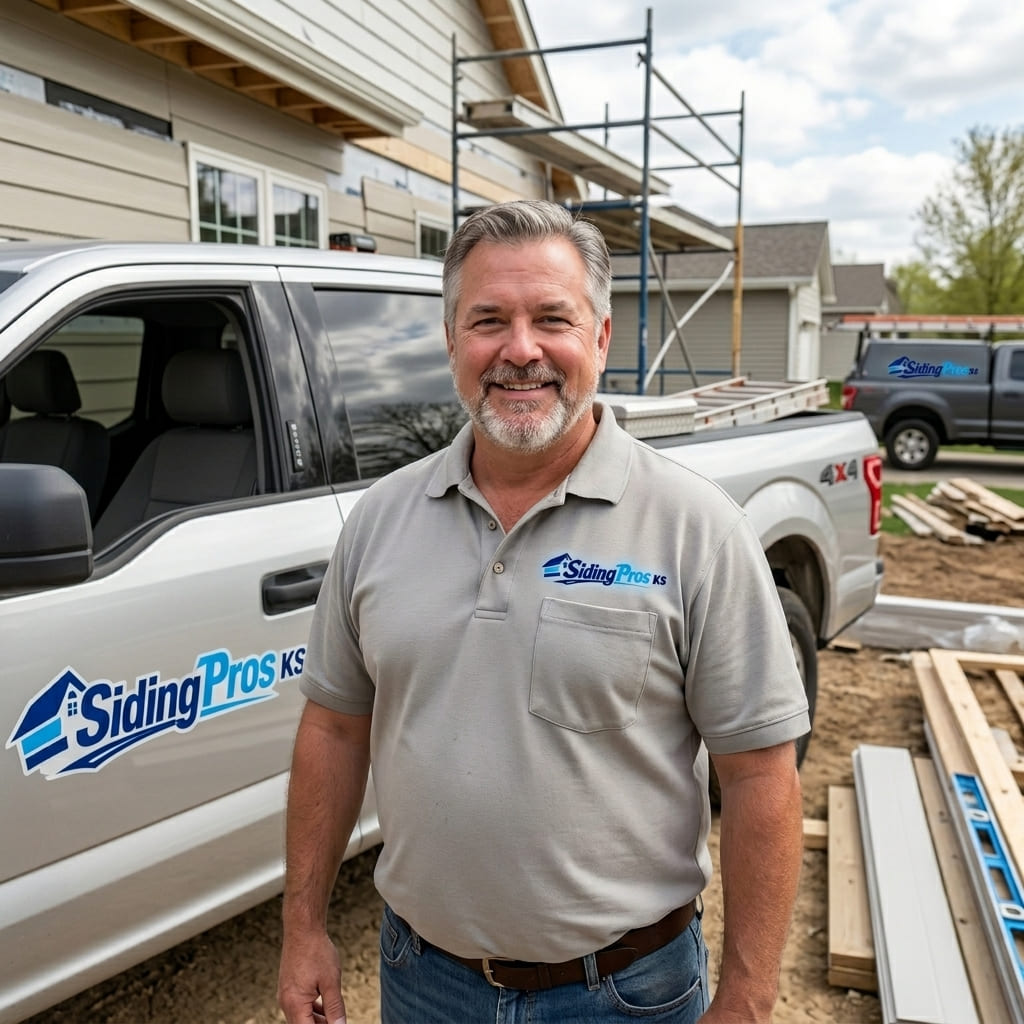
Siding Installation & Repair in Inman, KS
Inman sits in western McPherson County, a town of 1,341 at the 2020 census, platted in 1887 as Aiken and renamed two years later for Major Henry Inman. The country around it is deeply Mennonite — the Hoffnungsau congregation southeast of town, Bethel to the south, and Zoar southwest of town all trace to the settlement wave that began arriving in the county in September 1873. Just east and south of town lie the McPherson Valley Wetlands, and Lake Inman, at better than a hundred acres, is the largest natural lake in Kansas.
It is a farm town in the truest sense, and that shapes the housing stock in a way Siding Pros KS sees the moment we drive the section roads. Around Inman, a great many houses are clad in the same material as the machine shed — and that decision, made forty years ago for perfectly sensible reasons, is what most of our work in this town is about.
The logic was sound at the time. You were already buying steel panel by the bundle for a shop or a grain building, the co-op had it, it was cheap, it would never rot, and it would never need painting. So the house got sided out of the same order. We are not going to pretend that was foolish — plenty of those walls are still standing forty years on, which is more than can be said for some of the vinyl that went up in the same era.
The problem is that ag panel and residential steel siding are not the same product doing the same job. Ag panel is a long vertical sheet fastened straight through its face with exposed screws, engineered to keep rain off an unheated building. Residential steel siding comes in shorter interlocking courses with concealed fasteners, a real starter and trim system, and a heavier finish. Put ag panel on a heated, occupied, air-conditioned house and you have asked a barn product to perform as a building envelope. Three specific things then go wrong, and they go wrong on a predictable schedule.
The first is the screws. Every exposed fastener is sealed by a rubber EPDM washer compressed under the screw head, and that washer spends its entire life in direct sunlight. UV hardens it, it loses compression, thermal cycling walks the screw loose in its hole, and eventually every fastener on the wall is an open penetration through the panel. On a wall with hundreds of screws, that is hundreds of small holes. Exposed-fastener systems are supposed to get a re-screw cycle for exactly this reason, and almost nobody who sided a house out of the shed bundle was ever told so.
The second is the cut edges. The factory coating protects the face of the sheet, but every panel cut to length on site has raw steel at the bottom. That edge sits at the lowest, wettest, grittiest point on the wall, often close to grade and often in the throw of a sprinkler head. Rust starts there and creeps upward under the coating. On plenty of Inman homes the top eight feet of a wall look nearly new and the bottom eight inches are gone.
The third is the one that actually destroys houses, and it is invisible from outside. Steel has essentially no insulating value, so on a January night the back face of that panel is close to outdoor temperature. Warm, humid indoor air that reaches the cold back of the metal condenses on it, exactly the way a glass of iced tea sweats on the porch in August. If there is no ventilated air space behind the panel and no continuous air barrier stopping indoor air from getting there — and on a shed-panel install there rarely is either — that water forms inside your wall assembly all winter long, runs down, and soaks the sheathing and framing from the inside out. Homeowners tell us the roof must be leaking. It is not the roof.
Diagnosing it is quick. We pull a single panel and look at the back face. Condensation leaves an unmistakable signature: rust streaking running vertically down the hidden side, staining on the housewrap if there is any, and darkened or spongy sheathing behind. We take moisture readings, photograph everything, and put it in the written estimate.
None of this is an argument against metal. Done correctly, a steel wall is one of the best-performing exteriors you can put on a Kansas home — it does not rot, it shrugs off hail far better than vinyl, and it will outlast most of the alternatives. The difference is entirely in the assembly: a continuous air and water barrier, furring to create a genuine vented drainage cavity so the back of the panel can dry, insulation detailed so the dew point falls outside the wall cavity, concealed-fastener residential panels instead of face-screwed sheet, and proper closures at the top and bottom. Fiber cement and quality vinyl are both perfectly good answers here too, and our siding materials comparison lays out the honest trade-offs.
Siding Pros KS handles siding installation, siding replacement, and siding repair across Inman and McPherson County — licensed, insured, Kansas-owned, with itemized written estimates and a workmanship guarantee. We are in McPherson, Moundridge, and Hutchinson most weeks, so Inman is an easy run for us. Start with the signs you need new siding or the Kansas siding cost guide, then call and we will come pull a panel.
Popular siding services in Inman
Why Inman, KS Homeowners Choose a Local Siding Crew
Local, not storm-chasers
We are a Kansas crew, not an out-of-state caravan. When your Inman siding needs service down the road, we are still here to back it up.
Fast storm response
After hail or high winds hit McPherson County, exposed walls can't wait. We prioritize Inman storm damage to keep water out of your home.
Insurance claim help
We document Inman storm damage with photos and detailed estimates and meet your adjuster on site so nothing gets missed.
Good to know before you call.
What is the difference between ag panel and real residential steel siding?
Quite a lot, even though both are steel. Ag panel — the corrugated or R-panel sheet sold for machine sheds and grain buildings — is fastened through the face with exposed screws, comes in long vertical runs, and is engineered to keep rain off a barn. Residential steel siding is made in shorter interlocking courses with concealed fasteners, a proper starter and trim system, and a heavier factory finish designed for close-up appearance and thermal movement. Ag panel on a house is not automatically a disaster, but it was designed for a different job, and on a heated, occupied building it behaves differently than it does on a shed.
The screws on my metal siding are backing out. Why?
The rubber washer under the screw head has aged out. Exposed-fastener panels are sealed by an EPDM washer that compresses when the screw is driven — and that washer is the weak point, because it sits in direct sun for its whole life. UV hardens it, it loses its compression, thermal cycling works the screw loose in the hole, and now every fastener on the wall is an open penetration through the panel. That is why exposed-fastener systems need a re-screw cycle. Nobody who installed it on a house at the same time as the machine shed usually mentions this.
Why is there rust along the bottom edge of my panels?
Cut-edge corrosion. The factory finish protects the face of the sheet, but wherever a panel was cut to length on site, that edge is raw steel. It is the lowest point on the wall, it is where water and grit collect, and it is often sitting close to grade or splashed by the sprinkler. Rust starts at the cut and creeps upward under the coating. Getting the bottom of the wall up off grade, keeping mulch and soil down, and aiming irrigation away from the wall buys years — but once the creep is well underway, the panel is on a clock.
I get water running down the inside of my metal wall in winter. Is the roof leaking?
Usually not. That is almost always condensation, and it is the failure mode we see most often on metal-clad homes around Inman. Steel has essentially no insulating value, so in cold weather the back face of the panel drops to near outdoor temperature. Warm, humid indoor air reaching that cold surface condenses on it exactly the way a glass of iced tea sweats in August. If there is no ventilated air space and no continuous air barrier behind the panel, that water forms inside your wall assembly all winter, soaking the sheathing and the framing from the inside out.
So can metal be done right on a house?
Absolutely, and we install it — done properly it is one of the best-performing walls you can put on a Kansas home. The difference is the assembly, not the metal. Correct means a continuous air and water barrier, a real vented drainage cavity created by furring so the back of the panel can dry, insulation detailed to keep the dew point out of the wall cavity, and concealed-fastener residential panels rather than face-screwed sheet. See our metal and aluminum siding page — the material is not the problem, the shortcut is.
Is it worth re-siding a house that already has metal on it?
That depends on what is behind it, which is why we open a test area rather than guessing. Siding Pros KS pulls a panel, checks the sheathing with a moisture meter, and looks for the tell-tale rust streaking and staining on the back face that says condensation has been running down it for years. Sometimes the answer is that the wall is sound and a re-screw plus a bottom-of-wall repair gets you another decade cheaply, and we will tell you that. Sometimes the sheathing is gone. Either way you see photographs before you decide.
Inman siding project on your list? Let's handle it.
Free written estimates, honest timelines, and a local crew that stands behind the work.