
Siding Contractor in Galva, KS
Your local siding contractor for Galva and McPherson County — siding installation, replacement, and repair, including the wrapped soffits and fascia that look tidy from the street and have quietly sealed the attic shut.
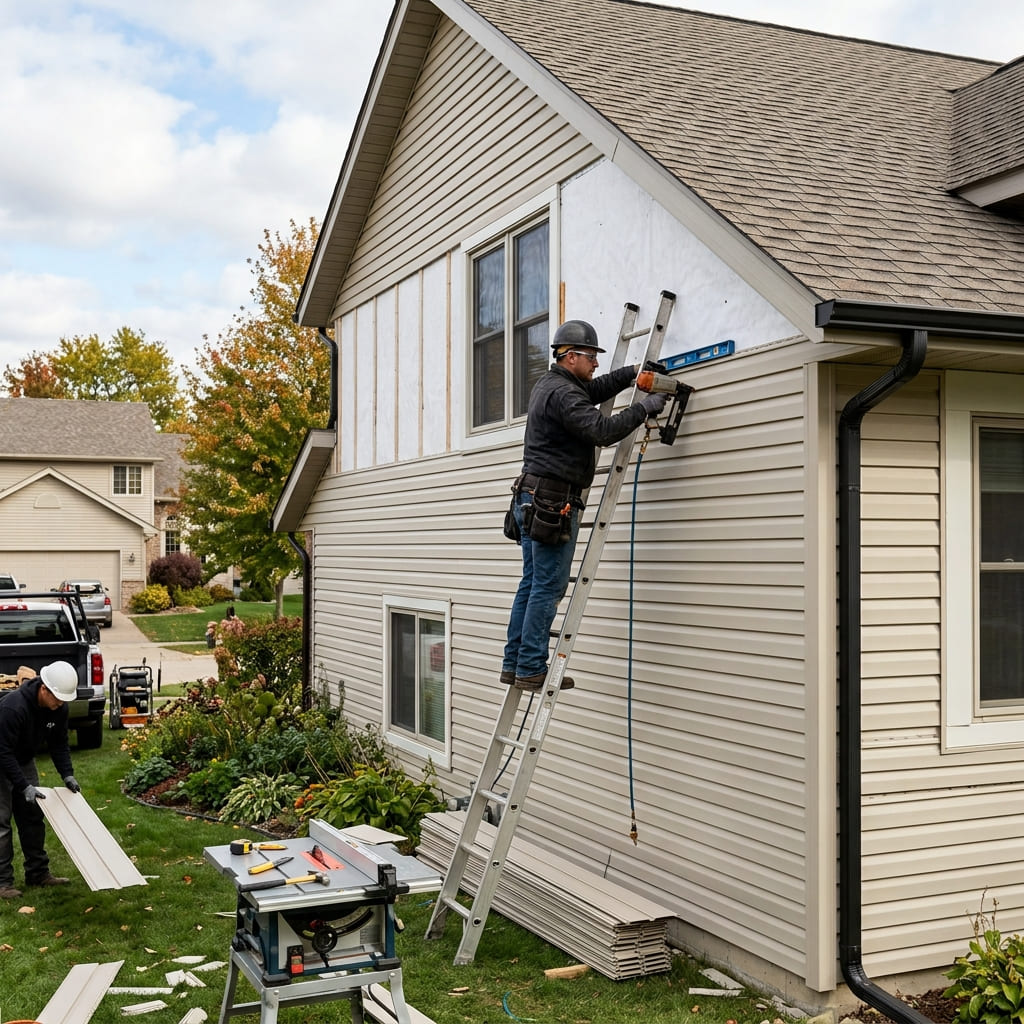
Siding Installation & Repair in Galva, KS
Galva was laid out in September 1879 on land belonging to the Marion & McPherson Railroad Company, and incorporated in 1887. It got its name from Galva, Illinois, at the suggestion of Mrs. J. E. Doyle, who had come from there. It sits at 1,545 feet on US-56, five miles east of McPherson and four miles east of I-135, and the 2020 census counted 834 people. Wheat, milo and soybeans come off the ground around it, and unusually for a town this size, oil is still produced inside the city limits as well as in the fields north, south and east of town. KDOT has been studying thirty-six miles of US-56 through McPherson and Marion counties; a proposed bypass south of Galva was dropped in favour of reconstructing the highway along the south edge of town.
Galva is small, its housing is mostly modest one-story frame, and the siding problem here is not a dramatic one. It is a quiet one, it is nearly always invisible from the street, and it is arguably the most under-diagnosed defect Siding Pros KS finds anywhere in McPherson County. It lives in the eaves.
Every re-siding job has two halves. There is the wall, which everybody looks at and everybody prices, and there is the eave — the fascia board running along the rafter ends, and the soffit closing off the underside of the overhang. The eave is where the gutter hangs, where wind-driven rain gets forced upward, where ice sits in February, and, critically, where your attic is supposed to draw in every cubic foot of air it breathes. It is also the part of the job that gets treated as trim.
Through the aluminum era and on into vinyl, the standard maintenance-free package was to wrap the fascia in coil stock and cover the soffit with panel. It looked sharp, it ended the painting, and on a great many houses it was done well. On a great many others two specific things went wrong, and they are still going wrong today.
The first is that the intake vents got covered. The classic version is a vented aluminum or vinyl soffit panel installed directly over the original solid wood or plywood soffit, with nobody cutting openings through the wood behind it. From the driveway the eave looks perfectly ventilated — you can see the slots. Behind the slots is a solid board. A second version is that the original soffit had small round vents or a screened strip and the wrap simply went over them. A third is that the openings survived but blown attic insulation has since slumped forward and packed the eave solid, because nobody installed baffles to hold it back. In all three cases the result is identical: the attic has exhaust at the ridge or in the gables and no intake at all.
An attic ventilation system is a loop. Cool air enters low at the soffit, rises as it warms, and leaves high at the ridge. Exhaust without intake does not simply run at reduced capacity — it starts drawing from wherever it can, and on most houses the path of least resistance is the heated space below. Air gets pulled up through can lights, the attic hatch, bath fan housings and plumbing penetrations, carrying with it all the humidity your household generates.
In a Kansas January that air meets a roof deck sitting at outdoor temperature and it condenses on the underside of the sheathing. You get frost on the nail points, sometimes heavily enough to look like the attic has snowed. When the sun comes out it melts, drips onto the insulation, and wets it — and damp insulation loses much of its R-value, so the ceiling you paid to insulate stops working. Do it for enough winters and the sheathing darkens and softens, the top plate of the wall stays damp, and the rafter tails at the eave go punky. Homeowners see stains on a bedroom ceiling and call a roofer, who finds nothing wrong with the shingles, because there is nothing wrong with the shingles.
Uneven melting from a warm attic also feeds ice dams in our freeze-and-thaw cycles, and dams push water backwards under the shingles at exactly the eave that is already compromised. In summer the same blocked intake stalls the attic, which drives ceiling temperatures up, runs the air conditioner longer, and cooks the shingles from below.
The second failure is simpler and more common than it should be: fascia wrapped instead of replaced. Coil stock bent over a soft, rotten fascia board hides the problem and traps water against the wood, so the rot accelerates in the dark. Meanwhile the gutter hangers are screwed into that decaying board. That is how a full gutter separates from a house in an ice storm and brings a length of eave down with it. Pulling the metal, replacing the bad wood, checking the rafter tails behind it, and then cladding costs a little more in material and a little more in labour, and it is the whole difference between a repair and a cover-up.
Checking your own house takes two minutes. Stand under the overhang and look up: can you see genuine openings, or a continuous flat panel with a decorative pattern? Press the fascia behind the gutter with a screwdriver handle — it should be solid. On a cold morning, put your head in the attic hatch and look for frost on the nail points and daylight at the eaves. If you have blown insulation, check whether it has migrated forward into the overhang.
Doing it properly means opening the soffit, verifying the framing behind it, cutting real intake openings, installing rigid vented soffit panel, fitting baffles at each rafter bay so insulation cannot choke the airway again, replacing rather than wrapping any failed fascia, and setting the drip edge and gutter apron so water is delivered into the gutter instead of behind it. It is unglamorous work and it is usually a small fraction of a full re-side.
Siding Pros KS handles siding installation, siding replacement, and siding repair across Galva and McPherson County, and we price the eaves as a visible line item rather than burying them. If the walls themselves are due, vinyl, James Hardie fiber cement, and steel and aluminum are all sensible answers on a house here — the materials comparison sets out which suits which budget. We are in McPherson, Moundridge, and Inman most weeks, so Galva is five minutes off our route. Have a look at the maintenance tips and the signs you need new siding, then call for a free estimate and we will get a ladder on the eave.
Popular siding services in Galva
Why Galva, KS Homeowners Choose a Local Siding Crew
Local, not storm-chasers
We work Galva year-round, not just the few weeks after a storm rolls through. When the wall needs attention down the road, the same number still reaches us.
Fast storm response
After hail or high winds hit McPherson County, exposed walls can't wait. We prioritize Galva storm damage to keep water out of your home.
Insurance claim help
We document Galva storm damage with photos and detailed estimates and meet your adjuster on site so nothing gets missed.
Good to know before you call.
What are soffit and fascia, and are they part of a siding job?
The fascia is the vertical board running along the ends of your rafters, the one the gutter is usually screwed to. The soffit is the horizontal underside of the overhang, the panel you see when you stand next to the house and look up. Together they close off the eave. They are absolutely part of a siding job, and any estimate that covers only the walls is quietly leaving out the part of the assembly that fails first — the eave is where water, ice, and wind all concentrate, and it is also where your attic is supposed to take in air. When we price a re-side we price the eave with it, and we itemize it so you can see exactly what it costs rather than finding it as a change order later.
My soffit has vent holes in it but the attic is still damp. How?
Because the holes may not go anywhere. This is the single most common defect we find on wrapped eaves. The vented aluminum or vinyl panel gets installed straight over the original solid wood or plywood soffit, and nobody cuts openings through the wood behind it. From the ground it looks perfectly vented. Functionally it is a sealed lid with a decorative pattern on it. The other version is that the openings do exist but blown attic insulation has slumped down into the eave and packed the airway solid, which is what happens when nobody installs baffles at the eave to hold the insulation back. Either way the intake is gone and the attic cannot breathe.
I get frost or dripping in my attic in winter. Is the roof leaking?
Usually not, and roofers get called out for this constantly. If there is no intake at the eaves, whatever exhaust you have at the ridge or the gables has to draw air from somewhere, and the easiest path becomes the house itself — warm, humid indoor air pulled up through ceiling light fixtures, the attic hatch, and plumbing penetrations. That air hits a roof deck that is sitting at outdoor temperature on a January night and condenses on it. You get frost on the underside of the sheathing and glittering on the nail points, and when the sun comes out it melts and rains on your insulation. People see wet insulation and stained ceilings and assume shingles. It is condensation, and it is a ventilation problem that starts at the eave.
Can you just wrap the rotten fascia in aluminum instead of replacing it?
We will not, and you should be wary of anyone who offers to. Coil stock wrapped over soft fascia is a lid, not a repair. The rot carries on out of sight, the metal traps water against the wood instead of letting it dry, and the fasteners holding your gutter are now anchored into something that is going soft — which is how a full gutter comes off a house in a Kansas ice storm and takes the eave with it. The right sequence is to pull the old fascia, look at the rafter tails behind it, replace what is gone, then clad. It is a modest amount of extra material and it is the difference between a repair and a cover-up.
Does covering the soffit vents really affect my energy bill?
It affects it in both seasons. In summer, an attic with no intake stalls out and heats up dramatically, and that heat radiates down through the ceiling insulation into the rooms below, so the air conditioner runs longer than it should. It also cooks the shingles from underneath, which shortens roof life. In winter the bigger cost is the moisture rather than the fuel: damp insulation loses a large share of its R-value, so the ceiling you paid to insulate is no longer doing the job. Restoring proper intake at the eave is not a glamorous line on an estimate, but it is one of the better-value items on it.
Is a job in Galva too small for you to come out for?
No. Siding Pros KS is in McPherson constantly and Galva is five miles east on US-56, so this is a short run rather than a special trip, and soffit and fascia work on a single elevation is a perfectly normal job for us to quote. We would rather come and look at an eave, tell you it needs four hours of work, and be the people you call in five years for the whole house. If we genuinely think you do not need the work yet, we will say so — that answer costs us a job and earns a customer.
Galva siding project on your list? Let's handle it.
Free written estimates, honest timelines, and siding detailed for Kansas weather.