
Siding Contractor in Haven, KS
Your local siding contractor for Haven and Reno County — siding installation, replacement, and repair, including the swollen, delaminating hardboard lap siding that is coming to the end of its life on streets all over this town.
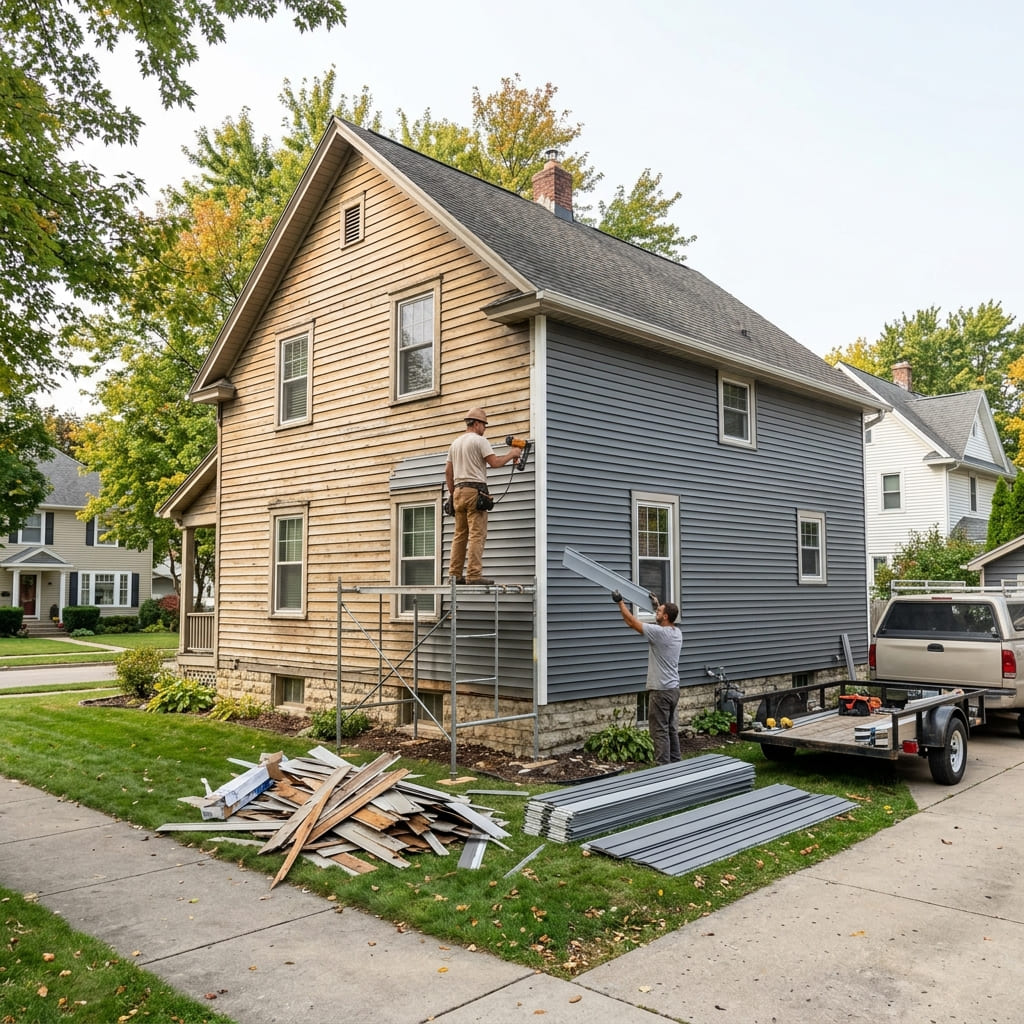
Siding Installation & Repair in Haven, KS
Haven sits in eastern Reno County on K-96, the road that puts Hutchinson twenty minutes one way and Wichita a little under an hour the other. The 2020 census counted 1,170 people inside its 0.78 square miles. The first post office opened in 1873, the townsite was laid out in 1886, and the city incorporated in 1901. It is the kind of place that turns up in state record books for odd reasons — the 1927 Haven football team beat Sylvia 256 to 0, a scoreline that still sits in the Kansas books, and Flossie Page, who lived here, reached 112 and was for a time the sixth-oldest person in the country.
What matters for siding is the commuter geography. Haven is a town people live in and drive out of, and that has kept a steady trickle of building and re-siding going for decades rather than producing one big cohort of identical houses. Drive the streets and you will see pre-war frame houses, mid-century ranches, and a good number of homes that were built or re-clad in the 1980s and 1990s. That last group is what most of our work in Haven is about, because a very specific product went on a very large number of American houses in exactly those years, and it is now failing on schedule.
The product is hardboard lap siding — pressed wood fiber and resin, formed into boards, coated at the factory, and sold as an affordable cedar-look alternative to real wood. It was a reasonable buy at the time. It was cheaper than cedar, it came in long lengths that went up fast, it held paint well when new, and it did not have the expansion problems that early vinyl did. Whole subdivisions across Kansas went up wearing it.
The trouble is what it is made of. A hardboard plank is wood fiber held together by resin under pressure, and wood fiber does exactly what wood fiber has always done when it gets wet: it drinks, then it swells. The factory coating protects the two faces. It does not protect the cut end where the installer trimmed the board to length, it does not protect the hole a nail punched through the face, and on many installs it barely protects the raw bottom edge at all. Every one of those is an entry point, and the bottom edge of every course is where the water on your wall ends up.
Once water is in the fiber the sequence is predictable and it does not reverse. The fiber swells. Swelling breaks the resin bond that was holding the board together, so the board begins to separate into layers — you can often peel it apart with a fingernail at the edge, which is why people describe it as looking like a soaked paperback. The swelling pushes the paint film off from underneath, so the wall starts flaking. Homeowners then repaint, the new paint fails inside two seasons because the substrate under it is still moving, and they repaint again. We have met plenty of people in Reno County on their third repaint of a wall that needed replacing after the first.
The damage is never random, which is useful, because the pattern tells you the cause. It concentrates at the bottom course, at butt joints over studs, directly under window sills, behind and below downspouts, at the base of the wall next to a deck, and anywhere a lawn sprinkler has been hitting the house every morning for fifteen years. If your damage does not follow that map, it is worth asking whether you are actually dealing with something else, and we will tell you if that is what we find.
You can identify it yourself in about five minutes. Press the bottom edge of a board with your thumb near a downspout — sound siding is hard, failing hardboard gives like stiff card. Look at the bottom edges across the whole elevation for that thickened, frayed, slightly mushroomed profile. Check the butt joints for gaps and darkened end grain. Find a cut end at a gable and look for layer separation. If you have a piece off the wall, the back face is smooth and faintly patterned rather than woodgrained, and the board is usually around 7/16 of an inch thick.
The lawsuits are worth knowing about, mostly as a dating tool. Masonite hardboard siding settled a national class action in 1998 for more than a billion dollars, covering siding installed between January 1980 and January 1998, with claims running through 2008. Louisiana-Pacific had its own litigation over Inner-Seal, made from 1985 to 1995, which closed in 2002. Both windows are long since shut, so there is no claim to file. But if the siding on your Haven home dates to that stretch and it is swelling at the edges, you are looking at a well-documented product failure rather than neglect on your part, and that is worth hearing.
None of this is an argument against engineered wood as a category. Modern engineered wood siding is a genuinely different product with a different treatment process and a real warranty, and installed correctly — proper clearance above grade and above roof surfaces, gapped and flashed butt joints, sealed cut ends, fasteners set flush rather than driven through the face — it performs well in this climate. We install it. We also install James Hardie fiber cement, which shrugs off the moisture problem entirely, and quality insulated vinyl, which is the value answer on a lot of Haven houses. The siding materials comparison lays the four options side by side, and the Kansas siding cost guide gives you real ranges before anyone comes out.
Siding Pros KS handles siding installation, siding replacement, and siding repair across Haven and Reno County, with itemized written estimates and no pressure to take the bigger job. We are through Hutchinson, South Hutchinson, and Buhler most weeks, so Haven is a short run. If you are trying to work out where you stand before you call, start with the signs you need new siding — and then get a free estimate, and we will probe the wall and show you photographs of what is actually going on behind the paint.
Popular siding services in Haven
Why Haven, KS Homeowners Choose a Local Siding Crew
Local, not storm-chasers
We work Haven year-round, not just the few weeks after a storm rolls through. When the wall needs attention down the road, the same number still reaches us.
Fast storm response
After hail or high winds hit Reno County, exposed walls can't wait. We prioritize Haven storm damage to keep water out of your home.
Insurance claim help
We document Haven storm damage with photos and detailed estimates and meet your adjuster on site so nothing gets missed.
Good to know before you call.
How do I know if I have hardboard siding?
Four checks, and you can do all of them from the ground. First, look at the bottom edge of a board near a downspout or close to grade — hardboard swells and frays there before it fails anywhere else, so the edge looks thickened, fuzzy, or slightly mushroomed rather than crisp. Second, press it with your thumb. Sound board is hard; failing board gives like stiff cardboard. Third, look at the butt joints where two boards meet over a stud — hardboard joints open up and the exposed end grain darkens. Fourth, find a cut end at a gable rake or behind a shrub and look at the edge: hardboard is a pressed wood-fiber panel, so a compromised edge shows visible layers separating like a wet paperback. Most of it is about 7/16 inch thick with a smooth, faintly patterned back face.
Why is the bottom of my siding wrecked when the top looks fine?
Because hardboard is only as good as its coating, and gravity decides where the water goes. The factory sealed the faces, but every cut end, every nail penetration, and every bottom edge is an opening into raw wood fiber. Water runs down the wall and sits at the lowest edge of each course, so that is where it wicks in first. Once fiber takes on water it swells, the resin bond that holds the board together starts to let go, and the board delaminates from the inside out. The swelling then pushes the paint off, which is why repainting a failing wall never holds — the substrate underneath is still moving. That is also why the damage clusters under windows, behind downspouts, along the bottom course, and anywhere the siding sits too close to a deck or to grade.
Can you just replace the bad boards instead of the whole wall?
Sometimes, and we will always price that option honestly rather than talk you straight into a full replacement. Two things usually decide it. The first is profile: most of these products have been out of production for decades, so an exact match for the reveal and the surface texture generally does not exist and a patch will read as a patch. The second, and the bigger one, is that the whole wall is the same age and has taken the same weather. If the bottom course has gone, the rest is typically a few wet seasons behind it. Spot repair makes real sense when the damage is confined to one elevation or one specific cause — a bad downspout, a deck ledger, a sprinkler head aimed at the house. It makes much less sense when four walls are all showing the same thing.
Was there not a lawsuit about this siding?
There were several, and they are worth knowing about because they help date what is on your house. Masonite hardboard siding was the subject of a national class action that settled in 1998 for more than a billion dollars, with a claims program covering siding installed between January 1, 1980 and January 15, 1998. That program ran through 2008. Louisiana-Pacific faced its own litigation over Inner-Seal, a faux-cedar product made from 1985 to 1995, and that settlement closed in 2002. Both claims windows are long shut, so there is no money left to file for. What the history does tell you is that if your siding dates to that stretch and it is swelling at the edges, you are looking at a documented product failure, not something you did wrong.
Is modern engineered wood the same stuff?
No, and it would be unfair to the product to pretend otherwise. Today engineered wood siding is a different formulation with a different treatment process and a real manufacturer warranty behind it, and it performs well in Kansas when it is installed to spec — correct clearance above grade and above roofing, gapped and flashed at butt joints, ends sealed, fasteners set flush rather than driven through the face. Plenty of houses around Haven have it and it is doing fine. The failures we are pulling off walls here are the older generation of pressed hardboard, not the engineered wood you would buy today. We install both engineered wood and fiber cement and we will lay out the honest trade-offs before you choose.
What should I do first if I think my siding is going?
Stop the water while you decide, because none of it is expensive. Get downspouts discharging away from the wall instead of at the foundation. Turn sprinkler heads so they are not spraying the siding every morning. Pull mulch and soil back so there are at least a few inches of clearance below the bottom course. Keep the paint intact, especially at butt joints and any cut end. Those steps buy you time; they do not reverse swelling, because wood fiber that has been wet does not go back. Then call Siding Pros KS and we will probe the wall, take moisture readings, photograph what we find, and put a line-item written estimate in front of you covering both the repair route and the replacement route so you can compare real numbers.
Haven siding project on your list? Let's handle it.
Free written estimates, honest timelines, and siding detailed for Kansas weather.