
Siding Contractor in Nickerson, KS
Your local siding contractor for Nickerson and Reno County — siding installation, replacement, and repair, including opening, drying, and correctly rebuilding walls that have taken water along the Arkansas River.
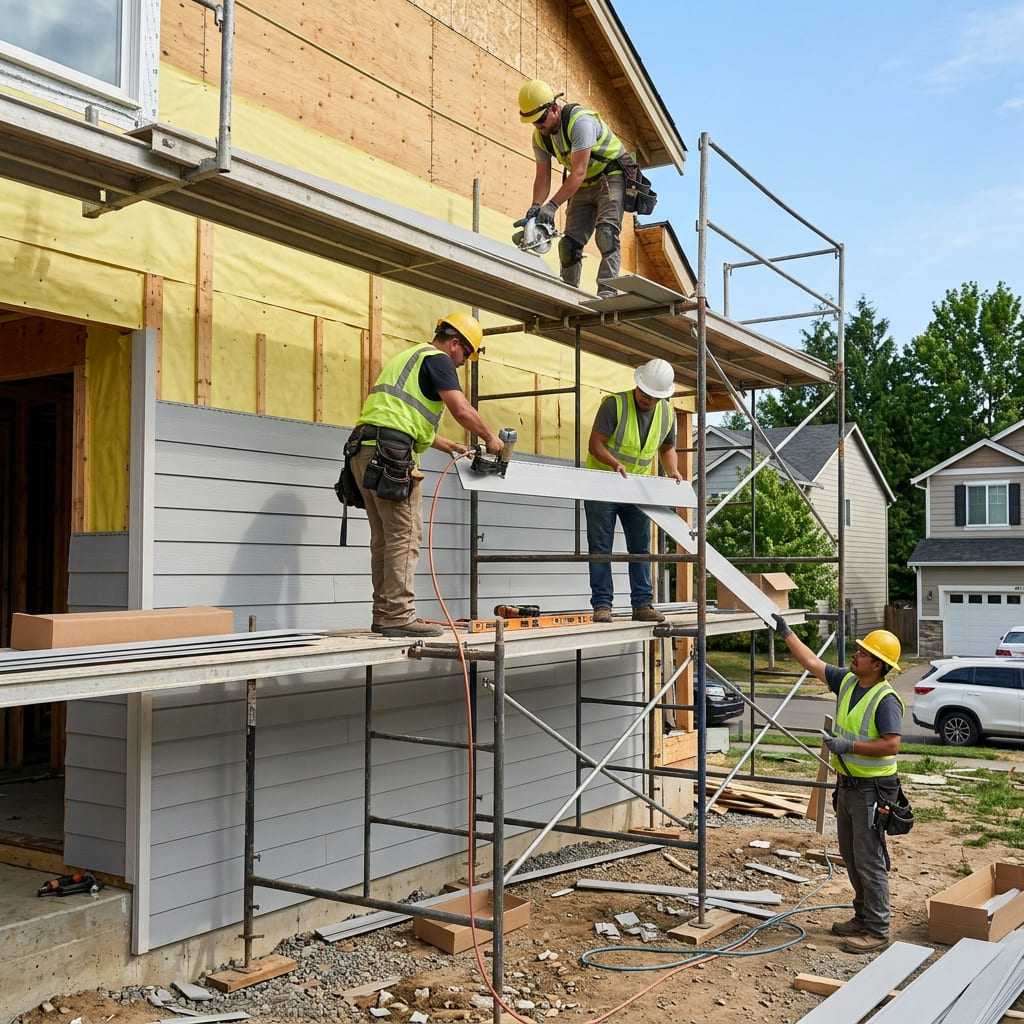
Siding Installation & Repair in Nickerson, KS
Nickerson was laid out in 1872 when the Atchison, Topeka and Santa Fe pushed its line to this point, and named for Thomas Nickerson, the railway president of the day. A schoolhouse went up in 1875, the city incorporated in June 1879, and a wooden bridge across the Arkansas River was finished that same year. The 2020 census counted 1,058 people at an elevation of 1,595 feet, and the Kansas and Oklahoma Railroad still runs through town. Most visitors know it these days for Hedrick’s, the exotic animal farm and bed and breakfast north of town where you can end up feeding a giraffe before breakfast.
The other fact that defines Nickerson is the one the town was built around: the Arkansas River. There is a USGS gauge named for this place — Arkansas River near Nickerson — and there is a reason somebody thought it worth measuring here. That river shapes the siding work in this town more than material, more than age, and more than weather.
The Arkansas across the Kansas plains is a wide, shallow, sandy channel, and in places its banks stand less than five feet above low water. That is a river that can be nearly dry one season and out of its banks the next, and it does not need much to make the change. NOAA has logged 56 flood events in Reno County since 1996 — 24 flash floods and 32 river or area floods — and the wet stretch of May 2019 put water across a great deal of south-central Kansas. In April 2018, FEMA and the Kansas Department of Agriculture Division of Water Resources released updated 100-year floodplain maps for parts of Reno County including Nickerson, Hutchinson, South Hutchinson and Willowbrook, drawn up after local efforts to re-certify the Arkansas River levees.
So a fair number of houses in and around this town have taken water at some point, and a fair number of walls in Nickerson were closed back up afterwards in a way that guaranteed trouble later. That is what Siding Pros KS is usually looking at here.
The critical thing to understand is that floodwater is not rain, and a wall that has been flooded is not a wall that got wet. Three differences drive everything else. Rain arrives on the outside face and runs down; floodwater arrives from below and rises into the cavity, so it is on the wrong side of your cladding from the first minute. Rain is clean; floodwater carries silt, sewage, fuel, fertilizer and whatever else was on the ground, and silt stays in the assembly after the water leaves. And rain stops; floodwater sits, sometimes for days, giving it time to saturate everything porous it touches.
What that means practically is that the siding itself is almost never the casualty. Vinyl comes through submersion fine. Fiber cement comes through fine. Hardboard and untreated wood do not, but even they are not the point. The damage is behind the cladding, in the sheathing, the framing, and above all the insulation.
Fiberglass batt is the worst of it. It holds water and silt, it does not shed either, it will not dry in place at any speed that matters, and its insulating value does not recover — a batt that has been under floodwater is contaminated material that has to come out, not a wet sponge that will be fine in a fortnight. OSB and hardboard sheathing swell and lose structural strength. Water wicks up through studs and sheathing well above the visible waterline, which is why the standard remediation approach is to open the wall to a height above the mark rather than stopping at it. And vinyl siding, so useful in every other respect, is a fairly effective barrier to outward drying, so a closed vinyl wall holds the cavity damp long after the yard looks fine. In a Kansas July, a wet, closed, dark wall cavity grows mold in days.
That is the reason we will not quote a simple re-side on a house that has been inundated. Putting new cladding on a wall that has not been opened, cleaned and dried is selling somebody an expensive lid.
The correct sequence is not complicated, but the order is not negotiable. Document everything first — photographs and video of the water line, the rooms, and the exterior, before anything is removed, because that record is what supports a claim and it cannot be recreated. Then remove the cladding and the sheathing to above the high-water mark, strip out all wet insulation, and get the silt out; mud packs into the bottom of a vinyl wall through the starter strip and weep slots and needs flushing, not wiping. Then clean and disinfect the framing. Then dry it, on instruments, to a verified moisture content — not until it feels dry, which is the single most expensive judgement call made in this county after a flood. Only then does the wall get closed and clad. Rushing the close-up means paying for the rebuild twice.
Rebuilding smart is worth a conversation while the wall is open, because it costs very little extra at that moment and nothing else will ever be that cheap again. Below the flood elevation, that means cladding that tolerates submersion, closed-cell foam or mineral wool rather than fiberglass in the cavity — or in some cases deliberately leaving the below-elevation cavity uninsulated — treated bottom plates, and hot-dipped galvanized or stainless fasteners. FEMA publishes guidance on flood-damage-resistant materials which is genuinely worth reading. And check where your parcel actually sits on the current map before you decide anything, because the 2018 re-mapping moved some properties in and some out; your county floodplain administrator can answer that in a phone call.
On insurance, one point saves a lot of grief: standard homeowners cover excludes flood. Rising water is a National Flood Insurance Program matter and it is separate cover, whereas wind-driven rain or storm-torn siding is an ordinary homeowners claim. Working out which one you are actually dealing with before the tear-off starts is worth an hour of anybody’s time. We write itemized estimates, photograph the damage in detail, and will meet an adjuster on site.
Siding Pros KS handles siding installation, siding replacement, and siding repair across Nickerson and Reno County, in vinyl, James Hardie fiber cement, and the rest — the materials comparison covers what suits a house near the river. We are in Hutchinson, South Hutchinson, and Buhler most weeks, so Nickerson is a short run north. If the water is down and you are trying to work out where to start, read the storm damage siding repair guide and the signs you need new siding, then call for a free estimate and we will bring a moisture meter before we bring a quote.
Popular siding services in Nickerson
Why Nickerson, KS Homeowners Choose a Local Siding Crew
Local, not storm-chasers
We work Nickerson year-round, not just the few weeks after a storm rolls through. When the wall needs attention down the road, the same number still reaches us.
Fast storm response
After hail or high winds hit Reno County, exposed walls can't wait. We prioritize Nickerson storm damage to keep water out of your home.
Insurance claim help
We document Nickerson storm damage with photos and detailed estimates and meet your adjuster on site so nothing gets missed.
Good to know before you call.
The water went down and my siding looks fine. Do I really have to open the wall?
Yes, and this is the hardest advice we give in Reno County because the outside genuinely does look alright. Vinyl and fiber cement both survive submersion — the cladding is almost never what was damaged. The damage is behind it. Floodwater rises into the wall cavity from below, saturates the sheathing and the bottom of the studs, and soaks the insulation, and none of that is visible from outside. Vinyl in particular then works against you: it is a fairly effective barrier to drying, so it holds the cavity damp long after the yard is dry. In Kansas summer heat a closed, wet wall cavity grows mold in a matter of days. Leaving it shut is not saving money, it is deferring a bigger invoice and living with the wall in the meantime.
How far up the wall do you have to open it?
Above the high-water mark, not to it. Water wicks upward through framing, sheathing, and especially through fiberglass batt insulation, so the genuinely wet zone typically runs a foot or more higher than the line you can see on the wall. Standard remediation practice is to remove finishes and insulation to a defined height above the mark rather than stopping at it, precisely because the visible line understates the damage. On a house where water was deep or stood for a long time, we cut higher. We take moisture readings to decide rather than guessing, and we show you the readings.
Will my homeowners insurance pay for this?
For flood damage, almost certainly not — standard homeowners policies exclude flood, which is why the National Flood Insurance Program exists as separate cover. It is a distinction that catches people out badly, and it matters which one you are dealing with, because a wind-driven rain event or a storm that tore siding off is a very different claim from rising water. That is worth working out before anyone starts tearing off. Whichever it turns out to be, photograph and video everything before you touch it, keep receipts, and do not haul the debris away until it has been documented. We write itemized estimates and will meet an adjuster on site.
Can we just run fans on it instead of opening the wall?
Not through the cladding, no. Air movement dries surfaces it can reach, and it cannot reach the inside of a closed wall cavity — that is exactly the space that stayed wet. Drying also has to be measured rather than judged. Framing needs to come down to a verified moisture content before anything gets closed back up, and "it feels dry" is not that. Closing a wall too early is the most expensive mistake made after a flood in this county, because you pay for the rebuild twice: once now, and again when the mold or the rot surfaces. If floodwater got into the assembly, it has to be opened, cleaned, and dried on instruments.
What siding should go back on a house in the floodplain?
Below the flood elevation the question is not really the siding, it is the whole assembly. Cladding-wise, vinyl and fiber cement both tolerate submersion and clean up; hardboard and untreated wood do not. Behind it, the choices matter more: fiberglass batt holds water and silt and has to be discarded after any real inundation, whereas closed-cell foam and mineral wool tolerate wetting far better, and in some cases the right answer below the flood elevation is deliberately leaving the cavity uninsulated. Treated bottom plates and hot-dipped galvanized or stainless fasteners are worth the small premium. FEMA publishes guidance on flood-damage-resistant materials, and it is a genuinely useful document to read before you spend money.
How do I find out whether I am in the mapped floodplain?
Check the current map rather than what you remember, because it changed. FEMA and the Kansas Department of Agriculture Division of Water Resources produced updated 100-year floodplain mapping for parts of Reno County, including Nickerson, Hutchinson, South Hutchinson and Willowbrook, and it went out for public review in April 2018 following local work to re-certify the Arkansas River levees. Some properties moved in and some moved out. Your county floodplain administrator can tell you where your parcel currently sits, and it is worth a call before you make decisions about elevation, insurance, or how to rebuild a wall. Siding Pros KS is not a flood consultant and we will not pretend otherwise — but we will build the wall to suit the answer you get.
Nickerson siding project on your list? Let's handle it.
Free written estimates, honest timelines, and siding detailed for Kansas weather.