
Siding Contractor in Bonner Springs, KS
Siding and stone veneer repair, replacement and installation across Bonner Springs and western Wyandotte County — including the drainage details that decide whether a stone wall lasts.
Siding Installation & Repair in Bonner Springs, KS
Bonner Springs counted 7,837 residents in the 2020 census, and it sits on rolling ground at the edge of the Kansas River in a part of the state that has been quarrying rock for a very long time — Lone Star ran limestone operations here, and Loring Quarries has been working the ground since 1977. It is a stone town, which makes it an unusually good place to explain the thing that goes wrong with stone on houses.
Because the stone on most Bonner Springs houses is not the stone that comes out of those quarries. It is manufactured veneer, a cast concrete product adhered to the wall, and it fails in a way that real masonry does not.
The history is worth a moment, since it explains the name. The Chouteau family established the first European trading post in Kansas here in 1812, a place called Four Houses. The settlement later took the name Tiblow, after Henry Tiblow, a Delaware man who ran the ferry across the Kansas River. When Philo Clark platted the town in the 1880s he renamed it Bonner Springs — Bonner for his friend Robert Bonner, and Springs for the many natural springs in the area. Water has been the defining feature of this place since before it had a name, which is fitting for what follows.
Why manufactured stone fails where real masonry does not
Manufactured stone fails because it looks like masonry and is not built like masonry. A solid stone or brick wall of the traditional kind manages water by mass and thickness — it absorbs, stores and releases moisture over a long cycle, and the wall itself is the barrier. Adhered manufactured stone veneer does none of that. It is a thin, cast cladding stuck to the outside of an ordinary wood-framed wall, and the framing behind it is exactly as vulnerable to sustained moisture as the framing behind vinyl.
That distinction is the whole problem, and it gets lost on job sites. A veneer treated as a barrier is built without a drainage path. Water that gets behind it — and water always gets behind it, through the veneer itself, around openings, at roof intersections — has nowhere to go. It sits against the sheathing, and sheathing that stays wet rots.
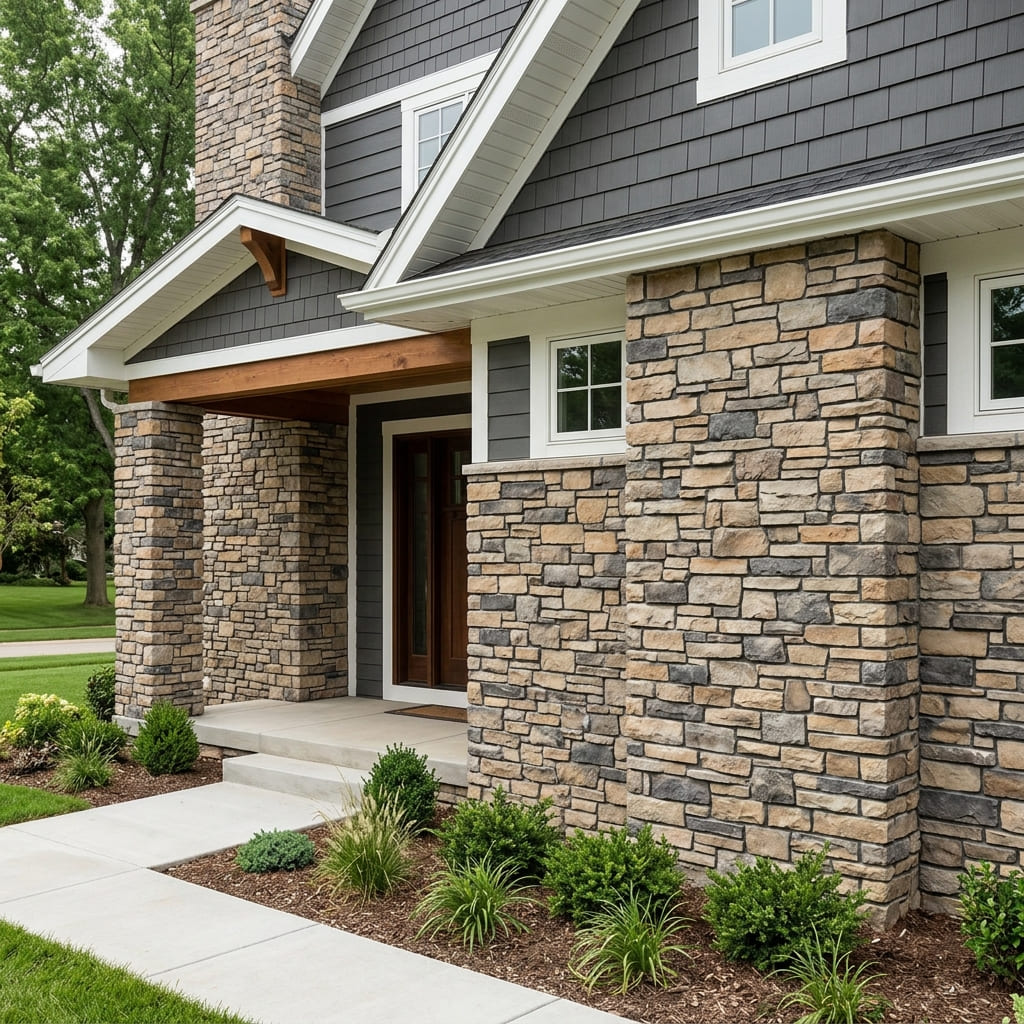
Look at the photograph at the top of this page. Stone runs down the columns and the wainscot and meets the planting beds at the base, which is where a great many of these installations are compromised. The base of an adhered veneer needs a weep screed with clearance above the ground so trapped water can leave. Stone carried down into soil or mulch seals the exit. Everything that gets in, stays.
The details that decide whether a stone wall lasts
Five details decide it, and they are all invisible once the stone is on. First, the water-resistive barrier behind the veneer has to be continuous and correctly lapped, shingle-fashion, so water running down the back of the stone is carried outward rather than inward. Second, metal lath must be fastened through the sheathing into structure, at the right spacing, because the veneer hangs off it and a lath fastening schedule that was guessed at will let go in sheets.
Third, the base needs a weep screed with clearance. The residential code provision covering adhered masonry veneer sets that at not less than four inches above earth, not less than two inches above paved areas, and not less than half an inch above an exterior walking surface carried on the same foundation as the wall. Your local code official is the authority on which edition applies to your house. Fourth, every horizontal transition needs real metal flashing rather than a bead of sealant. That includes window and door heads, the line where stone meets siding above it, and above all the kick-out flashing where a roof edge runs into a stone wall. A missing kick-out concentrates an entire roof plane’s runoff into one vertical joint, and it will find the framing behind the stone within a couple of seasons.
Finally, the assembly needs drainage capacity behind the veneer — a gap, a drainage mat, or a purpose-made product — so water has somewhere to run once it is in. Without it the mortar bed sits tight against the barrier and there is no route down to the weep screed even if the screed is there.
How to tell whether your stone is in trouble
You can tell a lot from the ground in ten minutes. Start at the base and look for white crusting or dark vertical streaking, which together say water is moving through the assembly and leaving at the bottom rather than draining properly. Then tap the stone with a knuckle or the handle of a screwdriver across the lower courses. Well-bonded veneer sounds solid and dead. Debonded veneer sounds hollow and drummy, and the drummy area is almost always larger than the visibly loose part.
Then look up. Check every place a roof edge dies into a stone wall and see whether there is a kick-out flashing turning water away from it, because that junction is where the worst of the hidden damage starts. Look at window heads for flashing rather than caulk. Look for cracking that steps diagonally at corners, and for stones that have moved out of plane. And look at the base again, this time for whether the stone disappears into soil or mulch.
If the answer to the base question is yes, and the answer to the kick-out question is no, the probability of wet sheathing behind that wall is high regardless of how good the stone looks from the street.
What a repair involves
A repair involves opening the wall, which is the part homeowners least want to hear and the part that cannot be skipped. Stone that has debonded came off because of water behind it, so putting the face back without correcting the drainage returns the wall to the condition that caused the failure. We sound the veneer to map the affected area, remove stone to sound material, inspect and replace the sheathing and framing where it has gone, rebuild the barrier, lath and drainage correctly, install the flashing that should have been there, and re-lay the stone.
Where the failure is confined to a base course with a buried weep screed, the fix is sometimes as modest as removing the bottom courses, correcting the screed and clearance, lowering the grade, and re-laying. Where a missing kick-out has been feeding one corner of a house for ten years, it is a considerably bigger job. The only way to know which you have is to open a small area and look, and that is a far cheaper investigation than the alternative.
Siding Pros KS handles stone veneer work alongside siding installation, replacement and repair throughout Bonner Springs and western Wyandotte County, in vinyl, James Hardie fiber cement, wood and metal. The materials comparison covers how stone pairs with the cladding above it, and the signs you need new siding covers the symptoms worth acting on.
We are in Kansas City and Basehor constantly and run up to Lansing, Leavenworth and Tonganoxie, so Bonner Springs is on the way to most of it. Call for a free written estimate, and if you have stones coming loose, photograph the base of the wall and the nearest roof-to-wall junction before you call.
Popular siding services in Bonner Springs
Why Bonner Springs, KS Homeowners Choose a Local Siding Crew
Local, not storm-chasers
We work Bonner Springs year-round, not just the few weeks after a storm rolls through. When the wall needs attention down the road, the same number still reaches us.
Fast storm response
After hail or high winds hit Wyandotte County, exposed walls can't wait. We prioritize Bonner Springs storm damage to keep water out of your home.
Insurance claim help
We document Bonner Springs storm damage with photos and detailed estimates and meet your adjuster on site so nothing gets missed.
Good to know before you call.
There are dark streaks and white crusting at the bottom of my stone. What is that?
Those are two separate symptoms of the same problem, which is water leaving the wall at the base instead of draining out of it properly. The white crusting is efflorescence — mineral salts carried out of the mortar by water moving through the assembly and deposited as the water evaporates. The dark streaking is staining from water running down the face and picking up what it passes. Neither is cosmetic. Both indicate that water is getting behind the stone and is not being drained away at the bottom, which is normally a missing or buried weep screed.
How can I tell whether my stone is real or manufactured?
Look at the back of a loose piece if you have one, and look at the corners if you do not. Manufactured stone is a cast concrete product with a flat, uniform back face and a distinctly moulded appearance, and because it is cast in a limited number of moulds you will find the same stone shape repeating across the wall if you look for it. Corners are the other tell, since manufactured systems use purpose-made L-shaped corner units. Natural stone has irregular thickness, no repeating shapes, and generally sits in a thicker assembly. The distinction matters because the two are installed and detailed completely differently.
Can you just reattach the stones that have come loose?
We can, but putting them back without finding out why they let go usually buys a year or two. Stones debond because water got behind the veneer and stayed there, breaking down the bond between the setting bed and the lath or freezing behind it and pushing the stone off. Re-adhering the face without addressing the drainage means the same water does the same thing to the same area. Before quoting a repair we sound the surrounding stone to map how far the debonded zone actually runs, because the loose pieces are usually the edge of a larger area rather than the whole of it.
My stone runs straight down into the flowerbed. Is that a problem?
Yes, and it is the single most common defect we find on these walls. Adhered stone veneer needs a weep screed at its base to let water that gets behind it drain back out, and that screed needs clearance — the residential code provision for adhered masonry veneer requires not less than four inches above earth and not less than two inches above paved areas, though your code official is the authority on which edition applies to your house. Stone carried down into a bed of mulch or soil buries the drainage path completely. Water that gets in has nowhere to leave, so it sits against the sheathing and the framing behind it. Raising the grade is sometimes part of the fix.
Is manufactured stone just a bad product?
No, and blaming the product usually misdiagnoses the failure. Manufactured stone veneer performs perfectly well when it is installed as a drained cladding over a functioning water-resistive barrier, with lath, a proper setting bed, a weep screed at the base and real flashing at every transition. What fails is the installation, not the material. The trouble is that it looks like masonry, so it gets treated on site like masonry — as if it were a wall that keeps water out by mass — when it is actually a rain-screen component that has to let water back out.
What should a correct stone veneer installation include?
Six things, and a quote that does not mention them is worth questioning. A water-resistive barrier behind the veneer, correctly lapped and continuous. Metal lath fastened through to structure. A scratch coat and setting bed to the manufacturer’s specification. A weep screed at the base with clearance above grade and paving. Real metal flashing at every horizontal transition, at window and door heads, and kick-out flashing where a roof edge meets a stone wall. And drainage capacity behind the veneer. Siding Pros KS will write these into a scope in plain language so you can compare it against anyone else’s.
Bonner Springs siding project on your list? Let's handle it.
Free written estimates, honest timelines, and siding detailed for Kansas weather.