
Siding Contractor in Lansing, KS
Siding repair, replacement and installation across Lansing and Leavenworth County — including the colour-matching problem that comes with repairing twenty-year-old vinyl.
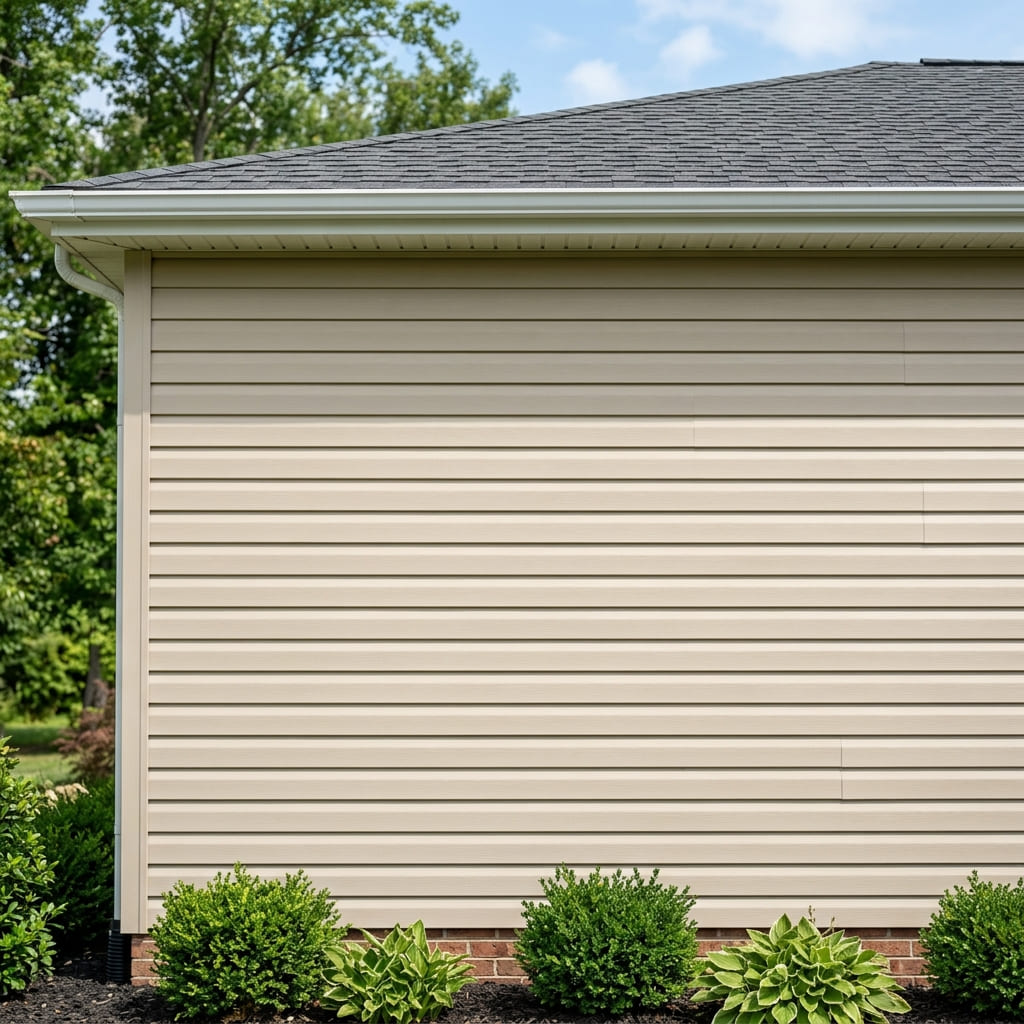
Siding Installation & Repair in Lansing, KS
Lansing counted 11,239 residents in the 2020 census against 11,265 in 2010, a net change of twenty-six people across an entire decade. A city incorporated in 1959 that grew hard and then levelled off produces a very particular housing stock, and it drives the single most common siding call we take from this town: can you match my panel?
The short answer is usually no, not exactly. The useful answer is that matching the panel is the wrong goal, and there is a better way to handle the repair that most homeowners have never had explained to them.
Why your siding colour cannot be matched
Your siding colour cannot be matched for three reasons that stack on top of each other, and understanding them saves a lot of frustration. The first is production. Vinyl manufacturers retire colours and profiles on a rolling cycle, and a panel installed on a Lansing subdivision house in 2003 is very likely out of production entirely. There is no shelf somewhere with your colour on it.
The second is fade, and it defeats even a perfect product match. Vinyl loses colour under ultraviolet exposure, and it does so unevenly across a single house — the south and west elevations shed noticeably more than the north and east. A house that left the factory as one colour is now, twenty Kansas summers later, three slightly different colours arranged by compass direction. A factory-fresh panel in the original named shade will not match any of them.
The third reason is geometry, and it is the one that surprises people. Profiles are not interchangeable between manufacturers. A single eight-inch panel and a double four-inch panel read completely differently on a wall even at the same colour. Butt thickness varies, the nail hem varies, and the lock at the bottom of the panel is cut differently from maker to maker — which means panels from a different brand frequently will not engage with what is already on your house at all. Gauge compounds it. Thinner vinyl telegraphs the wall behind it and reflects light differently from heavier material beside it.
What a good repair does instead
A good repair stops trying to hide the new material and starts controlling where the eye sees it. Two techniques do most of the work.
The first is replacing to a break line. A break line is any place the eye already expects a change — an inside or outside corner, a window line, a trim board, a change of plane between the wall and a bump-out. New panels that run to a corner read as a wall. The same panels stopped halfway across an open field of siding read as a patch, permanently, in every light. Taking a repair out to the nearest corner costs a modest amount of extra material and is the difference between a house that looks repaired and a house that looks fine.
The second technique is harvesting from your own house, and it is the one worth asking for by name. Your back wall carries panels that are a perfect match for your front wall, because they came off the same truck and aged on the same building. So we pull material from an elevation nobody sees — behind the garage, the wall facing the fence, a section screened by the deck — and use it to repair the elevation that matters. The new, slightly-off panels then go on the hidden wall. It is more labour than a straight patch and it produces a visibly better result.
Both of these depend on a thing that is free at installation time and impossible to buy later: attic stock. When siding goes on a house, ask the installer to leave a bundle of full-length panels and spare trim, and store them flat and out of the sun. Material kept in the dark does not fade. A decade on, that bundle is the only perfect match that will ever exist for your house.
Covenants, architectural control, and the impossible clause
Covenants complicate this in the subdivisions where they apply, and plenty of the platted developments around Lansing carry them. The clause that causes trouble is the standard one requiring replacement materials to match the existing. Written in 1998, that was a reasonable instruction. Applied in 2026 to a discontinued colour on a faded wall, it asks for something that no longer exists.
The way through it is procedural rather than technical. Establish whether your subdivision has an architectural control committee and what it actually requires, then submit the nearest available colour in writing and get the approval in writing before any material is ordered. Where an exact match is genuinely unobtainable, committees will normally approve a full-elevation or whole-house change to a current colour, because the alternative is a patchwork they like even less. What you should not do is order the material first and seek approval afterwards.
The cohort problem, and what to buy when it is your turn
The cohort problem is what makes Lansing different from an older town with a century of mixed construction. Houses here went up in concentrated waves, so the cladding on a given street was installed within a year or two, from the same supplier, by the same crews, to the same standard. Material that goes on together comes off together. When three houses on your block are being re-sided in one summer, that is not coincidence and it is not contagion — it is a service life expiring on schedule.
When it is your turn, gauge is the specification that matters most and the one most quotes leave vague. Heavier vinyl holds its shape against wind and hail, resists the wavy look that comes from thin material over an uneven wall, and takes a fastener better. Ask for the thickness in writing rather than a brand name. Ask what the warranty actually covers, whether it is prorated, and whether it transfers to the next owner — a transferable warranty is worth real money in a market where houses change hands regularly. And ask how the installer handles expansion, because vinyl that is nailed tight instead of hung loose will buckle in July no matter how good the panel was.
Siding Pros KS handles siding repair, replacement and installation across Lansing and Leavenworth County, working in vinyl, James Hardie fiber cement, wood, metal and stone veneer. If you are weighing a repair against a full replacement, the signs you need new siding sets out where the line usually falls, and the Kansas siding cost guide covers what drives the number.
We work Leavenworth, Basehor and Tonganoxie regularly, handle the off-post houses around Fort Leavenworth, and run south to Bonner Springs and Kansas City. Call for a free written estimate — and if it is a repair, send a photograph of the damaged area and a photograph of the whole elevation, because the second one tells us more than the first.
Popular siding services in Lansing
Why Lansing, KS Homeowners Choose a Local Siding Crew
Local, not storm-chasers
We work Lansing year-round, not just the few weeks after a storm rolls through. When the wall needs attention down the road, the same number still reaches us.
Fast storm response
After hail or high winds hit Leavenworth County, exposed walls can't wait. We prioritize Lansing storm damage to keep water out of your home.
Insurance claim help
We document Lansing storm damage with photos and detailed estimates and meet your adjuster on site so nothing gets missed.
Good to know before you call.
Can you match my existing siding colour?
Sometimes closely, almost never exactly, and it is better to hear that at the start. Three things work against a match. The colour may have been discontinued, since manufacturers retire shades and profiles on a rolling cycle and a twenty-year-old panel is usually long out of production. The panel on your wall has faded, so even the original product in the original shade now reads lighter than what is on the house. And profiles vary between makers in ways that stop them locking together. What we can usually do is get close enough that the difference sits somewhere nobody looks.
Why does a new panel look wrong even when the colour name is identical?
Because the wall has changed and the sample has not. Vinyl fades under ultraviolet light, and it fades unevenly — south and west elevations lose more than north and east, so a single house can carry two or three different shades of what was originally one colour. A factory-fresh panel in the same named colour will therefore look brighter than everything around it, and the contrast is sharpest on the elevations that needed the repair most. This is normal and it is not a defect in the new material. It is twenty years of Kansas sun showing up on the old material.
Do I really have to replace a whole wall for a few damaged panels?
Not always, but you should replace out to a break line rather than stopping in open wall. A break line is a place where the eye already expects a change — an inside or outside corner, a window line, a change of plane, a trim board. New panels stopped in the middle of a field advertise themselves permanently, while the same panels run to a corner read as a wall rather than a patch. On a small repair we would rather take the replacement out to the nearest corner than leave a rectangle of brighter vinyl in the middle of your front elevation.
Where do you get matching panels if the colour is discontinued?
From your own house, and it is the most useful trick in this situation. We take panels from an inconspicuous elevation — the back wall, the side hidden by the garage, a section behind a fence — and use those genuinely matched, genuinely faded panels to repair the visible elevation. The new, slightly-off material then goes on the wall nobody sees. You end up with a front elevation that matches perfectly and a back elevation with a difference you will never notice. It costs a little more labour and it looks dramatically better than the alternative.
Should I keep the leftover panels after an installation?
Yes, and it is worth insisting on it. Ask your installer to leave a bundle of full-length panels along with the trim pieces, and store them flat, out of sunlight, somewhere they will not warp — a garage rafter or a basement wall works. That stock is the only material that will ever be a perfect match for your house, because it comes from the same production run and it ages in the dark. Ten years on, when a mower throws a rock through a panel, those spares turn a visible repair into an invisible one.
Half my street is replacing siding this year. Does that mean mine is next?
Probably, and the reason is how Lansing was built. Subdivisions here went up in tight windows, which means the houses in them were clad within a year or two of each other with the same product from the same supplier, fastened by the same crews. Materials that go on together reach the end of their service life together. If neighbouring houses of the same age are failing, yours is on the same clock even if it looks fine. The practical advice is to get ahead of it, because when a whole neighbourhood turns over at once the good contractors book out and the door-knockers arrive.
Lansing siding project on your list? Let's handle it.
Free written estimates, honest timelines, and siding detailed for Kansas weather.