
Siding Contractor in Kansas City, KS
Your local siding contractor for Kansas City, Kansas and Wyandotte County — siding installation, replacement and repair, including the lead-safe removal that pre-1978 painted siding legally requires.
Siding Installation & Repair in Kansas City, KS
Siding work in Kansas City, Kansas is lead-paint work more often than it is not. The 2020 census counted 156,607 people in the city and 169,245 across Wyandotte County, the median house here dates to roughly 1961, and close to three in ten were finished before 1950 — every one of them painted, repainted and painted again in the decades before residential lead paint was banned in 1978.
That single fact reorganizes the whole job. On a house in Haven or Galva a re-side is a carpentry decision. On a house in Armourdale or Strawberry Hill it is a carpentry decision wrapped inside a federal work-practice rule, and the contractors who quote it as though that rule does not exist are the ones to worry about.
Before anything else, a point of order that costs Kansas City homeowners real money every year. There are two Kansas Cities, they sit on opposite banks of the state line, and search engines blend them relentlessly. Siding Pros KS works the Kansas side — Wyandotte County and the Kansas communities around it. Permits, inspections and assistance programs do not transfer across the river, so whoever you hire, confirm which state they actually work in before they start.
Why pre-1978 paint changes a siding job in Kansas City
Pre-1978 paint changes a siding job because removing siding is, in legal terms, disturbing a painted surface. The EPA Renovation, Repair and Painting rule applies to work on pre-1978 housing that disturbs more than twenty square feet of exterior painted surface, and it requires the firm doing the work to be EPA-certified and to follow a set of specific work practices. Twenty square feet is a patch of wall roughly four feet by five. A whole-house tear-off passes that threshold before the first morning break.
The reason the rule is written around exteriors at all is that the hazard is not really the paint sitting on your wall. Intact paint on a wall is comparatively inert. The hazard is what happens when somebody pries, scrapes, sands or torches it — paint chips and lead dust come off the wall and land in the soil around the foundation, in the grass where children play, and on the path back into the house.
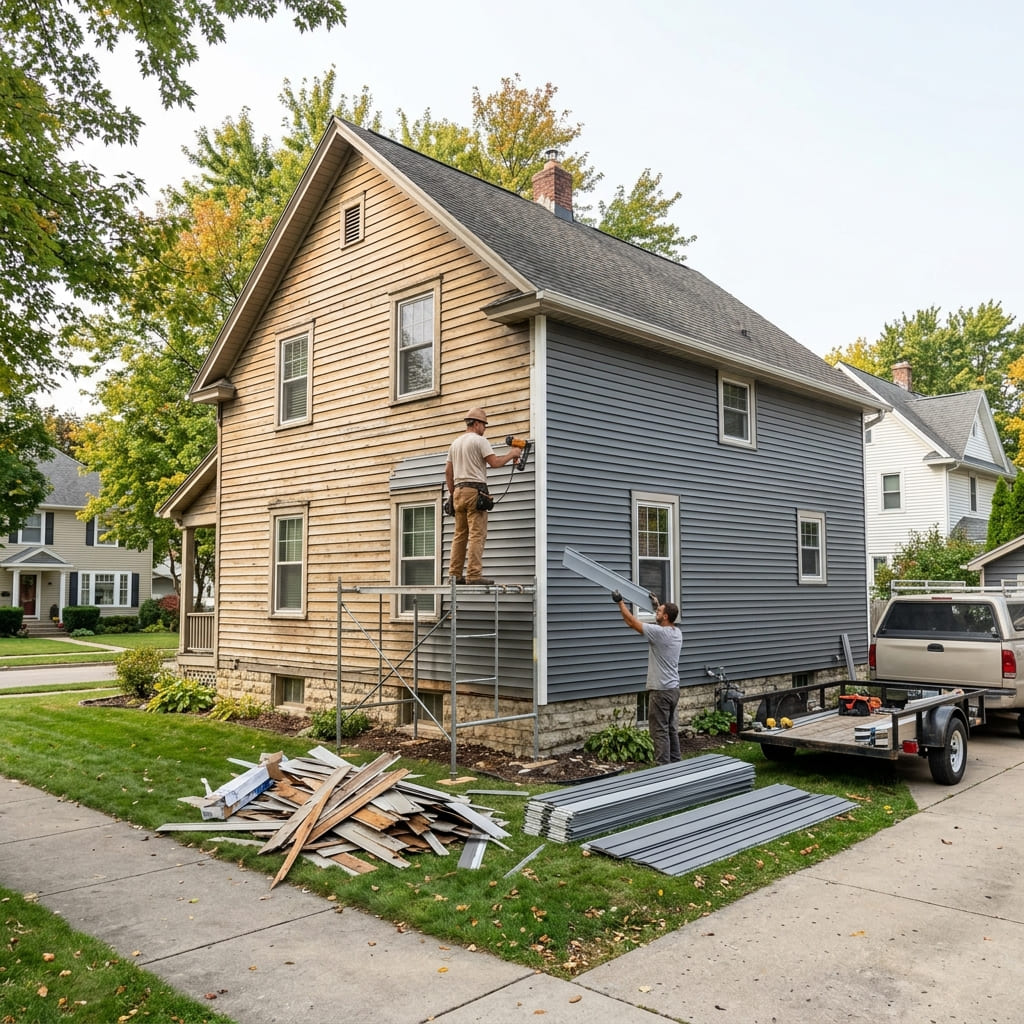
Look at the photograph at the top of this page and you can see the mechanism: stripped boards heaped loose on the lawn beside the sidewalk. On a post-1978 house that is a tidy-up problem. On a pre-1978 Kansas City house that same pile is exactly what the containment rules exist to prevent, and once chips are in the soil they do not weather away. They stay.
Lead in soil is not a theoretical concern in this county either. In August 2026 the EPA awarded $3.7 million to remediate 54 contaminated vacant lots in the Douglass-Sumner neighborhood in the northeast of the county, with roughly $2.7 million going to the cleanup itself and $1 million to further soil testing. Wyandotte County is already spending public money to get lead out of its ground. Adding more to it through a careless tear-off is a poor way to repay that.
What lead-safe siding removal actually looks like
Lead-safe siding removal looks like a slower, tidier, better-organized version of an ordinary tear-off, and the sequence matters. First, the homeowner receives the EPA Renovate Right pamphlet before any work starts, which is a requirement rather than a courtesy. Second, the work area gets contained: plastic sheeting laid on the ground extending ten feet out from the wall, weighted and sealed, with more distance allowed when it is windy, warning signage posted, and the perimeter kept clear of anyone not working. Third, windows and doors within twenty feet of the work are closed, and so are the neighbor’s where the wall sits tight to a property line — a genuine consideration on the narrow lots in Strawberry Hill and Armourdale.
Fourth, the removal itself avoids the three practices the rule prohibits outright. No open-flame burning or torching. No heat guns running at or above 1,100 degrees Fahrenheit. No power sanding, grinding, planing, needle gunning or blasting unless the tool has HEPA exhaust attached. Boards come off whole and get lowered rather than dropped, because a dropped board is a cloud of dust.
Finally the site is cleaned and verified. Debris is bagged and sealed on the sheeting rather than raked up afterwards, surfaces below the work are HEPA-vacuumed or wet-wiped, and a certified renovator carries out a documented visual inspection of the ground and the sills before the containment comes up. Records are kept for three years. None of that is exotic and none of it needs special equipment beyond HEPA vacuums and sheeting — it needs a contractor willing to spend the hours.
Verify the certification rather than taking a word for it. Ask every firm bidding your Kansas City house for its EPA firm certification number, and check it against EPA’s published list of certified firms before work begins. A contractor who finds that question insulting has answered it.
The Kansas City neighborhoods where this comes up most
The neighborhoods where this comes up most are the ones built before the war, and Kansas City, Kansas has an unusual number of them. Strawberry Hill sits on the bluff above Kaw Point, where the Kansas River joins the Missouri, settled in the late 1800s by Irish and German families and then by Croatian, Slovene and Serbian packinghouse workers who founded St. John the Baptist in 1900, St. George Serbian Orthodox in 1906, Holy Family in 1908 and Holy Trinity in 1917. The tall, narrow frame houses there sit on steep lots, close-packed, and are almost entirely pre-1978 — and because Interstate 70 was driven through the neighborhood in the 1950s and took roughly a third of the homes with it, what survives is the old stock.
Armourdale grew up around the packing plants and the railroads in the same era, and its cottages, bungalows and two-story frame houses date largely from the late 1800s and early 1900s. Argentine carries the same railroad history and much the same housing age. In all three, the walls are original wood lap or a mid-century layer laid over it, and the paint underneath goes back further than anyone living there.
Westheight is a different problem with the same answer. Platted in August 1915 by Jesse A. Hoel and laid out by the Kansas City landscape architects Hare and Hare, the Westheight Manor district was entered on the National Register on 26 March 1975 and includes houses by the architect Louis Curtiss. On a house like that the constraint is doubled: the paint is unquestionably leaded, and the exterior detailing is the reason the district is listed, so the removal has to be careful about the dust and the millwork both. Trim profiles, porch columns and window casings on those houses are worth saving and cannot be re-ordered from a supplier’s catalogue.
Go west and the picture inverts. Piper and the newer subdivisions out toward the county line are largely postwar and later, and a re-side there is an ordinary re-side with no containment cost attached. The lead conversation belongs to a specific half of this city. The build date decides which half you are in, not the zip code.
Paying for it, and what to put back on the wall
Paying for it starts with checking whether someone else will. The Unified Government of Wyandotte County and Kansas City public health department operates a HUD-funded lead abatement program, currently running as kNOw LEAD KCK, which helps qualifying households deal with lead-based paint hazards through a risk assessment and then either interim controls or full abatement. Ask specifically what exterior components the current grant covers, because that varies. Programs of this kind generally prioritize lower-income households in pre-1978 homes with a child under six or a pregnant resident, and the terms move with each grant cycle. It costs a phone call to Unified Government public health to find out where you stand, and that call belongs before you commit to funding the whole job yourself.
As for what goes back on the wall, the decision is mostly about not repeating the cycle. The appeal of vinyl and James Hardie fiber cement on these houses is that neither needs repainting on the schedule painted wood does, so the next owner is not scraping a leaded surface in fifteen years. Fiber cement holds an edge and a profile better against historic trim, which matters in Westheight. Vinyl costs less and suits a rental portfolio or a straightforward Armourdale bungalow. And where original clapboard is worth keeping, the right answer is sometimes to leave it in place, stabilize it, and enclose it rather than tear it off at all.
Siding Pros KS handles siding installation, siding replacement and siding repair across Kansas City, Kansas and Wyandotte County, in vinyl, fiber cement, wood, metal and stone veneer. The materials comparison sets out what suits a pre-war frame house against a postwar ranch, and the Kansas siding cost guide covers what actually drives the number on an estimate. If a wall is already failing, the signs you need new siding will tell you how urgent it is, and after hail or straight-line wind the storm damage siding repair guide is the place to start.
We also cover Bonner Springs, Basehor and Overland Park, and run up the corridor to Lansing and Leavenworth most weeks. Call for a free written estimate — and on a pre-1978 house, ask how the containment is priced before you ask what the siding costs. That answer tells you more about a contractor than the bottom line does.
Popular siding services in Kansas City
Why Kansas City, KS Homeowners Choose a Local Siding Crew
Local, not storm-chasers
We work Kansas City year-round, not just the few weeks after a storm rolls through. When the wall needs attention down the road, the same number still reaches us.
Fast storm response
After hail or high winds hit Wyandotte County, exposed walls can't wait. We prioritize Kansas City storm damage to keep water out of your home.
Insurance claim help
We document Kansas City storm damage with photos and detailed estimates and meet your adjuster on site so nothing gets missed.
Good to know before you call.
How do I know whether my Kansas City, KS house has lead paint?
Go by the build date first, because it is the single most reliable indicator you have. Lead paint was banned for residential use in 1978, so a house finished before then is presumed to contain it until testing says otherwise, and the older the house the higher the likely lead content. That presumption covers most of Kansas City, Kansas, where census survey data puts the median house at around 1961 and close to three in ten built before 1950. If your house predates 1978 and has ever worn painted wood siding, painted trim, or painted window casings, assume lead is present and plan the job around it. Testing can confirm it, but assuming it is there is never the wrong call.
Do you have to test for lead, or can you just assume it is there?
Assuming is allowed, and it is often the cheaper route. Under the EPA Renovation, Repair and Painting rule a contractor can either test the surfaces or simply presume lead is present and work lead-safe throughout, and presuming skips the testing cost entirely. Testing makes sense when you have a large house with mixed-age additions and you want to narrow down which elevations need full containment. It also makes sense if you are applying for assistance and need documented results. On a modest pre-1978 house in Wyandotte County where the whole exterior is coming off anyway, presuming is usually the sensible and less expensive decision.
Can I put new siding over the old painted wood instead of tearing it off?
Often yes, and on a pre-1978 house it deserves serious consideration rather than being treated as the cheap shortcut. Covering intact lead paint with new cladding puts a durable barrier over a hazard, and it disturbs far less paint than a full tear-off does. Two conditions decide it. First, the substrate underneath has to be sound, because you cannot cover rot — going over failing boards hides a problem instead of enclosing one. Second, even a go-over disturbs paint at cuts, corners, window returns and fastener points, so the lead-safe work practices still apply. What it is not is a way to skip containment.
Does lead-safe work make a siding estimate more expensive?
Yes, and an estimate that does not reflect it on a pre-1978 house is a warning rather than a bargain. Containment materials, ground sheeting, controlled removal, bagged waste, cleanup and the final verification all cost real time and real money, and they are why two quotes on the same Kansas City house can differ by thousands. The cheaper one is frequently cheaper because it plans to scrape your siding straight onto the lawn. Ask for containment and disposal as their own line items rather than folded into one number, so you can compare bids on the same basis.
Is there any help paying for lead work in Wyandotte County?
There is, and it is worth checking before you pay out of pocket. The Unified Government of Wyandotte County and Kansas City public health department runs a HUD-funded lead abatement program, currently branded kNOw LEAD KCK, which assists qualifying households with lead-based paint hazards. Funding of this kind typically prioritizes lower-income households in pre-1978 homes with a child under six or a pregnant resident. Ask what exterior work the current grant actually covers, because the scope differs between interim controls and full abatement. Eligibility, funding and waiting lists shift from one grant cycle to the next, so contact Unified Government public health directly for current terms. Siding Pros KS does not administer that program and cannot approve anyone for it.
Do you serve Kansas City, Kansas or Kansas City, Missouri?
Kansas, and the distinction matters more here than almost anywhere. Siding Pros KS works the Kansas side — Kansas City, Kansas and the rest of Wyandotte County, including Strawberry Hill, Armourdale, Argentine, Rosedale, Quindaro, Turner, Piper and Westheight, plus the surrounding Kansas communities in Leavenworth and Johnson counties. Search results for “Kansas City” blend both states constantly, so a contractor you find that way may be set up for the wrong side of the state line. Confirm which state a contractor actually works in before you book, because permits, inspections and local assistance programs are not interchangeable across the river.
Kansas City siding project on your list? Let's handle it.
Free written estimates, honest timelines, and siding detailed for Kansas weather.