
Siding Contractor in Basehor, KS
Siding repair, replacement and installation across Basehor and Leavenworth County — including the installation defects that show up on houses built during the boom.
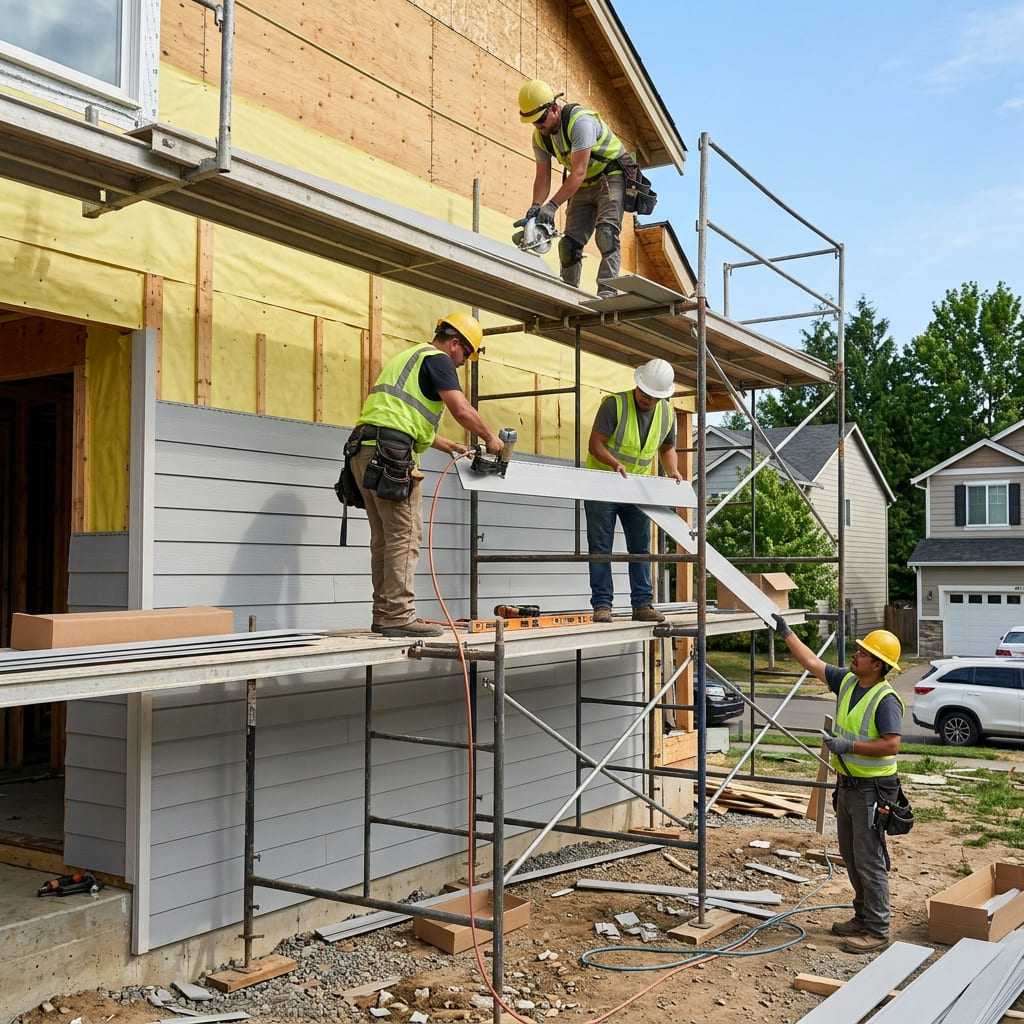
Siding Installation & Repair in Basehor, KS
Basehor gained 2,704 people between 2010 and 2020, a 64.5 percent increase that made it the fastest-growing city in Leavenworth County and brought the 2020 census count to 6,896. Around 58.6 percent of the housing here went up after the year 2000. That statistic is the whole story of siding in this town.
Because when a house is fifteen years old and its siding is failing, the material has not worn out. Modern cladding does not wear out in fifteen years. Something was built wrong, and it has been quietly getting worse behind a wall that looked fine the entire time.
Why a young house fails differently from an old one
A young house fails differently because the failure is a defect rather than a service life. On a hundred-year-old house in Leavenworth, deteriorated cladding is the expected end of a long and honourable career, and the conversation is about what to replace it with. On a 2008 house in Basehor, the same symptom means water has been entering the assembly since construction, and the conversation has to start with where.
That changes the order of work. Replacing the cladding on a house with an uncorrected water entry point buys you a wall that looks new and continues to rot. The defect has to be found and corrected first, which usually means opening a small area and looking rather than pricing a re-side off a walk-around.
It also changes who might pay. Nobody owes you anything for a wall that lasted ninety years. A wall that failed in twelve is a different question, and the answer to it depends on documentation you can only gather before the repair covers the evidence.
The defects that show up on boom-built houses
Four defects account for most of what we find, and they share a characteristic: each is quick to do wrong, invisible afterwards, and slow to produce a symptom. First is the water-resistive barrier. Housewrap works by shedding water downward and outward, which requires every sheet to lap over the one below it and the pieces around openings to be sequenced correctly. Reverse-lapped wrap, or wrap taped in the wrong order at a window, delivers water into the wall with perfect efficiency. It is one of the most common findings and one of the least visible.
Second is head flashing. Every window and door head needs a metal flashing that carries water out over the cladding below. A bead of sealant is not a substitute — sealant is a maintenance item with a service life of a few years, and when it fails there is nothing behind it. Sealant in place of flashing at openings is, in our experience, the single most frequent defect on houses of this vintage anywhere in the metro.
Third is fastening. Vinyl has to hang rather than be pinned, with the nail centred in the slot and left slightly loose so the panel can move; nails driven tight cause the buckling that shows up on the first hot July afternoon. Fiber cement has its own rules about nail type, length, placement and whether it is blind-nailed or face-nailed, and those rules are not interchangeable with vinyl practice. Fourth, on fiber cement specifically, field-cut edges need sealing. A board cut on site exposes an unsealed edge, and manufacturers require those cuts to be treated. Unsealed cut ends wick water and swell, and they are usually the first place a fiber cement wall starts coming apart.
There is a fifth worth mentioning because it is cheap to check yourself. Cladding needs clearance — from grade, from roofing, from paving. Siding run down into soil or mulch, or carried tight onto a roof surface, holds water against its own edge indefinitely.
Who pays, and the clock that is already running
Who pays depends on warranty tiers most homeowners have not read since closing. The common structure runs roughly one year on workmanship, two years on systems, and ten years on major structural elements. Siding and its flashing generally sit in the shortest tier. That is the trap: the coverage on the thing that was done wrong expires years before the wall shows what was done wrong.
The manufacturer’s product warranty is separate, usually much longer, and frequently transferable to a subsequent owner — but it covers defects in the material and excludes damage caused by improper installation. When the failure is an installation failure, which it usually is, the exclusion sits exactly on top of the problem. It remains worth filing, because a written manufacturer response identifying installation as the cause is useful documentation.
Beyond the warranties, Kansas limits how long after construction a claim can be brought at all. We are siding contractors and not lawyers, so take the specifics from someone qualified to give them — but know that the window is finite and that it started running when the house was built, not when you noticed the stain. That is the practical argument for documenting early even if you intend to do nothing with it.
Documenting it properly
Documenting it properly takes an afternoon and preserves every option you might want later. First, photograph the symptoms from outside and inside, with dates. Second, have a controlled inspection opening made in the affected area, small and deliberate, and photograph what is behind the cladding — the lap direction of the wrap, the presence or absence of flashing at the opening above, the condition of the sheathing, the fasteners.
Third, get a written scope and estimate describing what was found in specific terms rather than general ones. Fourth, put your complaint to the builder in writing and keep the reply. Finally, keep everything together with your closing documents. If you decide to pursue it, you have a file. If you decide to fix it and move on, you have lost nothing but an afternoon — and you still know what actually needs correcting, which is the part that determines whether the repair holds.
Siding Pros KS handles siding repair, replacement and installation across Basehor and Leavenworth County, in James Hardie fiber cement, vinyl, wood, metal and stone veneer. The materials comparison is useful if a defect has pushed you into replacing an elevation anyway, and the signs you need new siding covers what is worth acting on now.
We work Bonner Springs, Lansing, Tonganoxie and Leavenworth weekly, and cover the off-post market around Fort Leavenworth and down into Kansas City. Call for a free written estimate — and if you think you are looking at a defect rather than wear, say so, because the inspection is different.
Popular siding services in Basehor
Why Basehor, KS Homeowners Choose a Local Siding Crew
Local, not storm-chasers
We work Basehor year-round, not just the few weeks after a storm rolls through. When the wall needs attention down the road, the same number still reaches us.
Fast storm response
After hail or high winds hit Leavenworth County, exposed walls can't wait. We prioritize Basehor storm damage to keep water out of your home.
Insurance claim help
We document Basehor storm damage with photos and detailed estimates and meet your adjuster on site so nothing gets missed.
Good to know before you call.
My house is barely fifteen years old and the siding is already failing. Is that normal?
No, and that is the important thing to understand before you spend money on it. Modern cladding materials installed correctly have service lives measured in decades, so a wall that is coming apart at ten or fifteen years is almost never reporting worn-out material. It is reporting an installation defect, a missing flashing, or a water problem that has been running since the house was built. The distinction matters because it changes both the fix and the question of who should pay for it. Re-cladding over an uncorrected defect produces the same failure on a slower clock.
Is this covered by my builder warranty?
It depends which warranty period you are in, and this is where most people find out too late. Builder warranties are commonly tiered — roughly a year on workmanship and finishes, around two years on systems, and about ten years on major structural elements. Siding and its flashing usually sit in the shortest of those tiers, which means the coverage has often expired long before the consequences become visible. That is not an accident of your builder; it is how the standard structure works. Read your actual warranty document rather than relying on the summary you remember from closing.
What about the manufacturer warranty on the siding itself?
It exists, it is usually long, and it very often does not help. Product warranties cover defects in the material — delamination, cracking, colour failure beyond a stated limit — and almost universally exclude damage resulting from improper installation. Since the overwhelming majority of failures on newer houses are installation failures rather than material failures, the exclusion lands precisely where the problem is. It is still worth registering the claim and getting the manufacturer’s written response, because a denial that identifies the installation as the cause is useful documentation in any other direction you take this.
How would I prove the siding was installed wrong?
By opening a small, deliberate area and photographing what is behind it. The evidence in these cases is never on the surface — it is the housewrap lapped the wrong way, the window head with a bead of caulk where a flashing should be, the fastener driven through the face of a panel, the cut edge that was never sealed. A controlled inspection opening of a square foot or two, documented with dated photographs and a written description of what was found, is far more persuasive than a general complaint that the siding looks bad. Do that before any repair work covers the evidence up.
What defect do you find most often on newer houses out here?
Water management at openings, by a wide margin. Specifically, window and door heads finished with sealant instead of a metal head flashing, and housewrap cut and taped around the opening in a sequence that directs water into the wall rather than out of it. It is quick to do wrong, it is completely invisible once the cladding is on, and it takes several years to produce a symptom anyone notices. By the time a stain appears on drywall below a window, the sheathing under that opening has usually been wet through a number of seasons.
Should I just fix it and move on rather than chase anyone?
For many people that is the right call, and there is no shame in it. Pursuing a construction claim takes time, usually needs a lawyer, and Kansas limits how long after the work you can bring one — so the calculation depends heavily on how much money is involved and how long ago the house was built. What we would suggest regardless is documenting properly before the repair, because that costs almost nothing and preserves the option. Get the photographs and the written scope first. Decide what to do with them second.
Basehor siding project on your list? Let's handle it.
Free written estimates, honest timelines, and siding detailed for Kansas weather.