
Siding Contractor in Fort Leavenworth, KS
Siding installation, replacement and repair for Fort Leavenworth families — on the houses you buy off post in Leavenworth County, assessed fast enough to fit an inspection window.
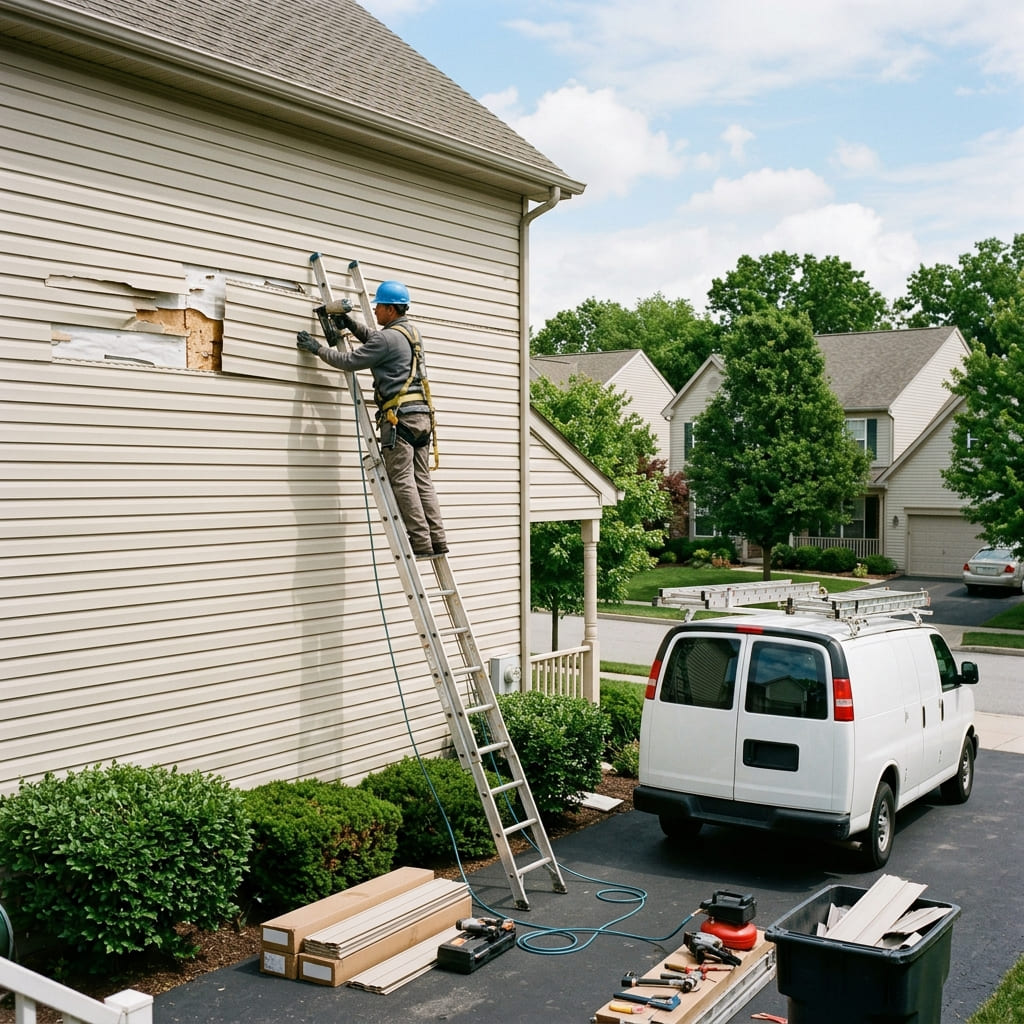
Siding Installation & Repair in Fort Leavenworth, KS
Fort Leavenworth is the oldest active Army post west of the Mississippi River, established in 1827 and spread across roughly 5,600 acres on the bluffs above the Missouri. It is also the one place in Kansas where the answer to “can you re-side my house?” is no. If you live in quarters on post, that house is not yours to re-clad, and this page is not really about it.
It is about the other siding decision Fort Leavenworth hands people, which is far more consequential and comes with a much shorter deadline: the house you buy off post, usually in a weekend, usually sight-unseen until the week you arrive.
Why on-post quarters are not a job you can hire out
On-post quarters are not a job you can hire out for two separate reasons, and both of them are absolute. The first is ownership. Family housing at Fort Leavenworth is privatized, owned and managed by Fort Leavenworth Frontier Heritage Communities under the Army’s Residential Communities Initiative, covering around 1,580 three- and four-bedroom multiplexes, duplexes and eightplexes. A resident is a tenant. Exterior maintenance runs through the housing partner, with the garrison Housing Oversight Office there to escalate a request that stalls.
The second is historic status. A 213-acre National Historic Landmark District was designated on the installation in 1974, and it contains buildings that predate the state — The Rookery, built around 1834, is the oldest continuously occupied residence in Kansas and once housed a young Lieutenant Douglas MacArthur. Work on quarters of that age carries federal review that has nothing to do with what a homeowner would normally arrange.
So the practical advice for a resident with a damaged wall is short. Report it the day you notice it, get the work order number in writing, photograph the damage yourself, and escalate through the Housing Oversight Office if nothing moves. What you should not do is let a contractor who knocked on your door convince you that you can authorise exterior work on a house you do not own.
The siding problem that does belong to Fort Leavenworth families
The siding problem that belongs to Fort Leavenworth families is a timing problem. The Command and General Staff College runs on a roughly one-year cycle, which means a large share of the people arriving here will buy a house, live in it for twelve to twenty-four months, and sell it to the next family doing exactly the same thing. That churn is the defining economic fact of housing around this post, and it shapes the walls.
A house that changes hands every eighteen months accumulates cosmetic maintenance and defers structural maintenance. Nobody re-sides a house they are selling next spring. What they do is caulk the gap, paint the stain, replace the three worst panels, and move on — and each owner in that chain inherits a slightly worse wall behind a slightly fresher surface. Twenty years of that produces the specific thing we find around here: siding that photographs well and is holding water.
The compressed house-hunting trip is what turns that into a purchase you regret. A few days to find a house, an inspection window measured in days, orders that do not flex, and a seller who also has a report date. It is precisely the situation in which people skip the exterior and focus on the kitchen. The walls are where the money is hiding.
What to check on the walk-through, in order
Check the walls in a fixed order and you will find in ten minutes most of what matters. First, walk the north and west elevations, because north walls dry slowest and west walls take the weather — if a house has one bad side, it is almost always one of those two. Second, press hard with your thumb along the bottom two courses and under every window. Sound cladding pushes back. Anything that gives, flexes, crumbles or sounds hollow is reporting on the sheathing behind it, not on itself.
Third, look at where the siding stops. It should finish several inches clear of soil, mulch and paving, and a bottom course buried in a raised flowerbed is a wick. Fourth, examine every penetration — hose bibs, dryer vents, electrical meters, light blocks, the AC line set — because unsealed penetrations are the most common single entry point for water and the cheapest thing to find early. Finally, look for mismatched panels or a patch of slightly different colour, which usually marks a repair that treated the symptom.
One more item specific to this market. If the house was built before 1978 and the paint is peeling anywhere on the exterior, raise it with your lender early. VA appraisals judge a property against minimum property requirements as well as value, and defective exterior paint on a pre-1978 house is the sort of condition that generates a required repair before closing. Finding that at appraisal rather than at inspection is how a PCS move ends up with a family in temporary lodging for three extra weeks.
Selling on a short rotation
Selling on a short rotation is a different calculation from selling a house you have lived in for fifteen years. A full re-side rarely pays for itself inside a twelve-month hold, so the goal is not to improve the house — it is to remove the discoveries. A buyer’s inspector who finds soft sheathing has handed the buyer a renegotiation worth several times the cost of the repair, and on your timeline you have almost no leverage to refuse.
The approach that works is to get the exterior looked at before you list, fix the things that are genuinely failing, and document them. Then disclose cleanly. A written invoice for a repair already completed is a far stronger position than a discount demanded three days before closing, and it does not cost you the schedule you cannot afford to lose.
Siding Pros KS covers the houses Fort Leavenworth families actually buy — across Leavenworth, Lansing, Basehor and Tonganoxie, and down into Bonner Springs and Kansas City. We handle siding installation, replacement and repair in vinyl, James Hardie fiber cement, wood and metal.
If you are under contract and the clock is running, say so when you call — inspection-window visits get priority because the window does not move. The signs you need new siding guide is worth ten minutes before a walk-through, and the Kansas siding cost guide will tell you roughly what a finding is going to be worth in negotiation.
Popular siding services in Fort Leavenworth
Why Fort Leavenworth, KS Homeowners Choose a Local Siding Crew
Local, not storm-chasers
We work Fort Leavenworth year-round, not just the few weeks after a storm rolls through. When the wall needs attention down the road, the same number still reaches us.
Fast storm response
After hail or high winds hit Leavenworth County, exposed walls can't wait. We prioritize Fort Leavenworth storm damage to keep water out of your home.
Insurance claim help
We document Fort Leavenworth storm damage with photos and detailed estimates and meet your adjuster on site so nothing gets missed.
Good to know before you call.
The siding on my on-post quarters is damaged. Who do I call?
Call the housing partner, not a siding contractor. Family housing at Fort Leavenworth is privatized and operated by Fort Leavenworth Frontier Heritage Communities, so maintenance and repairs on those quarters run through them, with the garrison Housing Oversight Office available if a request stalls or you disagree with how it is being handled. A resident cannot commission exterior work on a house they do not own, and a contractor cannot lawfully take that job from you. If a storm has opened a wall, report it the same day and ask for the work order number in writing so there is a record of when it was called in.
Do you work on post?
No, and no private siding company should tell you otherwise. The installation covers roughly 5,600 acres and includes a 213-acre National Historic Landmark District designated in 1974, with quarters that fall under federal historic review in addition to the privatized housing arrangement. Work inside the gate is contracted through the Army and its housing partner, not arranged by residents. What we do cover is everything around it — Leavenworth, Lansing, Basehor, Tonganoxie and the rest of Leavenworth County — which is where the houses Fort Leavenworth families actually buy are located.
We are PCSing to CGSC and house-hunting off post. What should we look at?
Walk the north and west elevations first, because those are the walls that stay damp longest and take the weather. Press firmly on the bottom two courses and around every window; sound siding resists, and anything that gives, crumbles or sounds hollow is telling you the sheathing behind it has gone. Check that the siding stops several inches clear of the soil and mulch rather than being buried in a flowerbed. Look for a patch of panels in a slightly different shade, which usually means something was repaired cosmetically rather than corrected. Take photographs of anything you find and get a price before you waive inspection.
Will siding problems hold up a VA appraisal?
They can, and it catches buyers out on a compressed timeline. VA appraisals assess the property against minimum property requirements rather than just valuing it, and exterior conditions that let water in or leave defective paint surfaces are the kind of thing that draws a condition. On a house built before 1978 the paint question is treated seriously because of lead. That does not mean the deal dies — it usually means repairs get required before closing, which is a scheduling problem when you have orders and a report date. Find the defects during your inspection window, not at appraisal.
We are only here a year. Is it worth replacing siding before we sell?
Usually not the whole house, and usually yes on the specific failure. A full re-side rarely returns its cost inside a twelve-month hold, but a buyer’s inspector finding soft sheathing behind a wall costs you far more in renegotiation than the repair would have. The practical approach for a short rotation is to fix what is actually failing and leave what is merely dated. Get a written scope and price, decide whether to repair it or disclose and price accordingly, and have the documentation ready — a short-timeline sale goes far better when the answer to a discovered defect is a paid invoice rather than a surprise.
How quickly can you get out to look at a house we are under contract on?
Inspection-window work is the one thing we try hardest to turn around fast, because the window does not move. Tell us the deadline when you call and we will tell you honestly whether we can make it. A walk-and-price visit on a house you are buying is straightforward — we look at the elevations, probe what needs probing, and give you a written number you can take into negotiation. Siding Pros KS covers Leavenworth County and the Kansas City side of the metro, so the drive out to a Fort Leavenworth family’s prospective house is a short one.
Fort Leavenworth siding project on your list? Let's handle it.
Free written estimates, honest timelines, and siding detailed for Kansas weather.