
Siding Contractor in Tonganoxie, KS
Storm damage siding repair, replacement and installation across Tonganoxie and Leavenworth County — for a town with a reputation for being spared that its own history does not support.
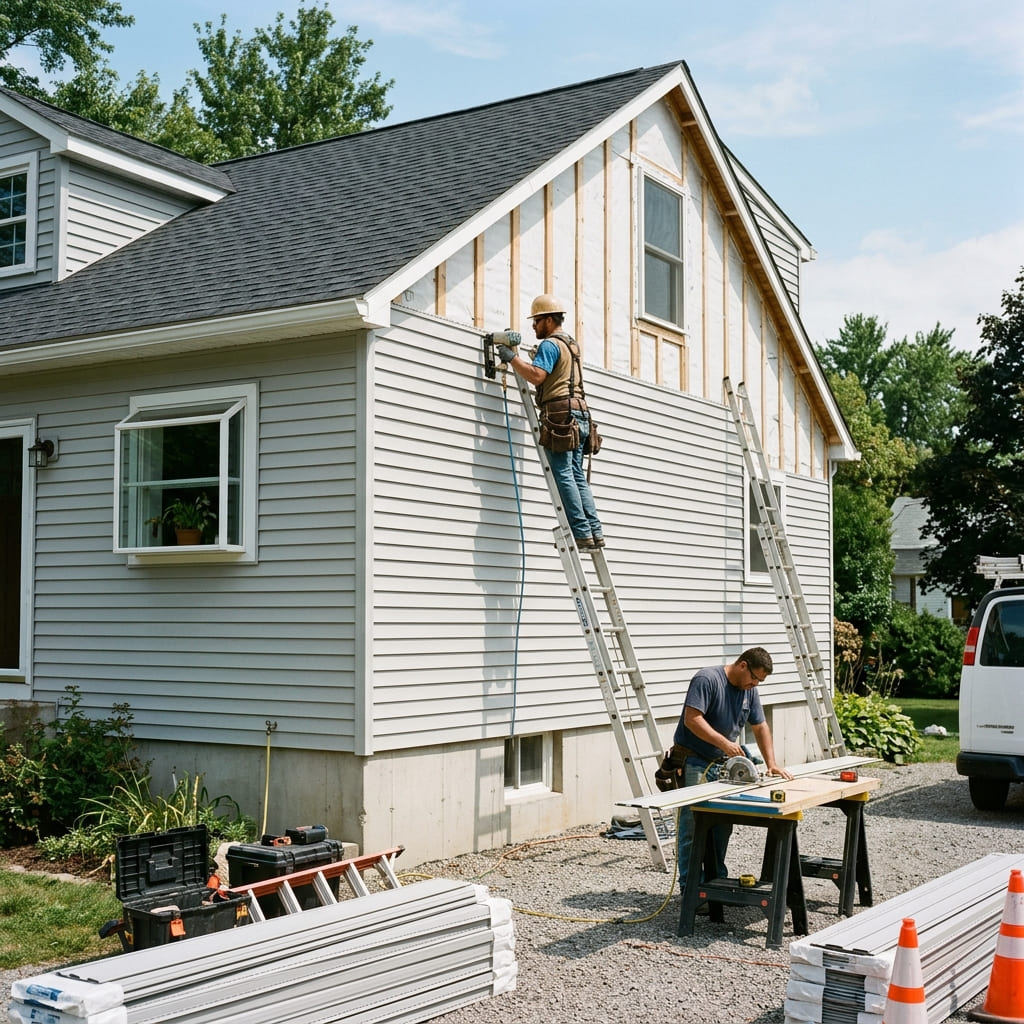
Siding Installation & Repair in Tonganoxie, KS
Tonganoxie counted 5,573 residents in the 2020 census, sits about 28 miles west of Kansas City, and is the only town in Kansas with a weather legend named after it. The Tonganoxie Split holds that severe storms divide and weaken as they approach, passing harmlessly around the town and sparing the metro behind it.
It is a wonderful story. It is also the reason a certain number of walls in this town have not been looked at in fifteen years, and that is a costly thing for a legend to do.
What the Tonganoxie Split actually is
The Tonganoxie Split is folklore that acquired the vocabulary of meteorology, which is what makes it so durable. The story has circulated through Kansas City weather talk for decades — a Kansas City Times piece in 1984 recorded WDAF’s Dan Henry referring to it on air, and it has been part of the regional conversation ever since. The name attaches to Chief Tonganoxie, though the decree of “no more storms” that gets quoted in connection with it referred to an end to violence rather than to anything about the weather.
The National Weather Service office at Pleasant Hill has addressed it directly. Their warning coordination meteorologist has described the Split as ingrained in the Kansas City weather lexicon while lacking scientific backing, and pointed to confirmation bias as the mechanism that keeps it alive. Storms that split get remembered and retold. Storms that do not, get forgotten.
And storms genuinely do split. Supercells divide for reasons to do with their own internal structure and the atmosphere they are moving through, and anyone watching radar over eastern Kansas will see it happen. What does not happen is a town causing it. The clearest local evidence arrived at 9.55 on the evening of 11 May 2000, when an F1 tornado came through Tonganoxie from the west. It destroyed structures on the west side of Hubbel Hill — the high ground outside town that has held the Tonganoxie Cemetery since shortly after the Civil War — damaged the cemetery itself, tore apart buildings at the Leavenworth County Fairgrounds, took the roof off the elementary school and wrecked businesses downtown. Damage across the town was estimated in the millions. The storms know nothing about the arrangement.
Why a piece of folklore becomes a siding problem
A piece of folklore becomes a siding problem through the decisions it quietly licenses. A homeowner who believes their town is structurally lucky does three things differently. They do not inspect after a storm that passed nearby, because the assumption is it went around. They defer maintenance on a wall that looks acceptable from the driveway. And they are slower to file a claim, because the event that caused the damage did not feel like a real hit.
None of those are dramatic errors. They just compound. The damage that costs the most on a house is almost never the damage everybody saw happen — it is the cracked butt edge nobody noticed, letting water behind a panel for six years until the sheathing under a window goes soft.
What actually reaches this town, and what it does
What reaches this town is the ordinary severe weather of eastern Kansas, and each type damages cladding differently. Hail is the one people underestimate on siding, because hail damage to vinyl usually does not look like a dent. It produces cracks, chips, punctures and small star-shaped fractures, often on the butt edges where impact concentrates, and it is close to invisible when you look straight at the wall. Seen from the side in low sun it is obvious. Fiber cement chips and spalls instead. Metal dents and holds the dent.
Wind does something different and more abrupt. Vinyl is designed to hang loose and move, and it holds on through the lock at the top of the panel below. When wind gets under a bottom edge at a corner or a gable rake — the places where pressure concentrates — a single panel can release, and once one lets go the wall can unzip along a course in seconds. That is why a house can lose a whole elevation in a storm that left the roof untouched.
Wind-driven rain is the quietest of the three and often the most expensive. Rain moving horizontally gets past laps, up behind butt joints and around openings that would shed a vertical fall without difficulty. It leaves no exterior mark at all. The evidence turns up months later as a stain inside, or years later as rot found during a re-side.
What to do in the week after a storm
Work through it in order and you will be in a far better position than most. First, photograph before you touch anything — wide shots that establish which elevation is which, then close-ups in raking light. Second, walk all four elevations rather than the one that faced the storm, because wind wraps around a building and the leeward corners take uplift. Third, check the soft evidence: dented gutters, torn screens, bruised vents and downspouts tell you what size stone hit the house even when the siding is ambiguous.
Fourth, report the claim promptly and keep damaged material rather than throwing it away. Finally, get an independent, itemised written estimate before you settle anything, and be deliberate about who you hire. Storm work draws crews who move across states behind the weather, quote fast, ask for money up front and are hard to find when a detail fails two winters later. Read anything you are asked to sign, particularly if it assigns your insurance benefits, and get a second estimate even when you are told the price expires today.
Siding Pros KS handles storm damage siding repair, replacement and installation across Tonganoxie and Leavenworth County, in vinyl, James Hardie fiber cement, wood, metal and stone veneer. We write itemised estimates, photograph damage in detail and will meet your adjuster on site. If you are unsure whether what you are looking at is damage, the signs you need new siding is the place to start.
We cover Basehor, Lansing and Leavenworth constantly, run east to Bonner Springs and Kansas City, and west to Topeka. Call for a free written estimate — and if a storm went through last night, take the photographs before you call.
Popular siding services in Tonganoxie
Why Tonganoxie, KS Homeowners Choose a Local Siding Crew
Local, not storm-chasers
We work Tonganoxie year-round, not just the few weeks after a storm rolls through. When the wall needs attention down the road, the same number still reaches us.
Fast storm response
After hail or high winds hit Leavenworth County, exposed walls can't wait. We prioritize Tonganoxie storm damage to keep water out of your home.
Insurance claim help
We document Tonganoxie storm damage with photos and detailed estimates and meet your adjuster on site so nothing gets missed.
Good to know before you call.
Is the Tonganoxie Split real?
It is a real piece of local folklore and it is not a real meteorological protection. The National Weather Service office at Pleasant Hill has described it as ingrained in the Kansas City weather lexicon while lacking scientific backing, and attributes its persistence to confirmation bias — the storms that do split are remembered and retold, the ones that do not are forgotten. Storms genuinely do split, because supercells split for reasons to do with their own structure and the surrounding atmosphere. They do not split because of a town in Leavenworth County. Nothing about your address changes how you should maintain a wall.
Has Tonganoxie actually been hit?
Yes, and the clearest counterexample to the legend is local. On the night of 11 May 2000 an F1 tornado came through town from the west, destroying structures on the west side of Hubbel Hill, damaging the Tonganoxie Cemetery there and the Leavenworth County Fairgrounds, taking the roof off the elementary school and hitting businesses downtown. That event is the direct refutation of the idea that storms cannot reach here, and it is worth knowing about when you are deciding whether to inspect a wall or assume it is fine. The belief that a place is spared tends to survive the evidence that it was not, which is exactly what makes it expensive.
How do I tell whether hail damaged my vinyl siding?
Look along the wall rather than at it, in low sun, from the side. Hail damage to vinyl frequently does not read as a dent — it appears as cracks, chips, punctures and star-shaped fractures that vanish when you look straight on and jump out in raking light. Check the elevation the storm came from, which in this part of Kansas is usually the south and west. Run a hand along the butt edges of the panels where impact concentrates. And look at the softer materials nearby, because dented gutters, torn screens and bruised roof vents all tell you the stone size that hit your house.
A contractor knocked on my door the day after the storm. Should I use them?
Be careful, and slow the process down. Storm work attracts crews who follow weather across states, quote fast, take a deposit, and are difficult to reach when a detail fails two winters later. There is nothing wrong with an out-of-area company as such, but you want a written scope rather than a figure, a physical local address, and the ability to find them next year. Never sign a document that assigns your insurance benefits to a contractor without reading it properly. Get more than one estimate even when you are being told the price expires this afternoon.
Will insurance cover hail damage to siding?
Often yes, and how you handle the first week matters more than most people expect. Photograph everything before any repair, including close-ups in raking light and wide shots that establish which elevation you are looking at. Report the claim promptly, because policies contain time expectations. Keep damaged material rather than disposing of it. Then get an independent written estimate that itemises the work, so you have something specific to discuss with the adjuster instead of a single number. We write itemised estimates and will meet an adjuster at the house.
My part of town never seems to get hit. Should I still check the walls?
Yes, because most of what damages siding here is not the dramatic event anyone remembers. Straight-line wind, wind-driven rain and marginal hail do cumulative damage that never generates a story — loosened panels, cracked butt edges, lifted corners, sealant driven out of joints. None of it makes the news and all of it lets water in. Walking your four elevations twice a year, after the spring storm season and before winter, takes twenty minutes and catches the things that would otherwise be found by a buyer’s inspector or a ceiling stain.
Tonganoxie siding project on your list? Let's handle it.
Free written estimates, honest timelines, and siding detailed for Kansas weather.